

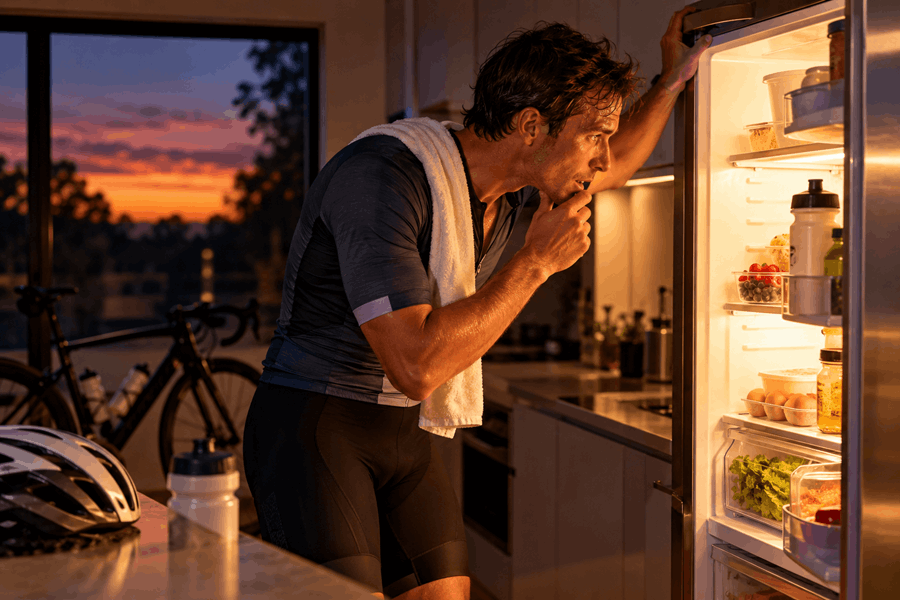
| Quick Answer: A 2026 randomized crossover trial in the American Journal of Clinical Nutrition found that people ate about 400 more calories at their next meal and roughly 547 more over the following 24 hours after an evening workout than after the identical session in the morning.[1] Eating before the workout didn’t eliminate the higher energy intake associated with evening exercise. Earlier cycling research points the same direction. Planning your post-ride dinner, front-loading protein, and setting a kitchen cutoff are the simplest ways to keep evening rides from turning into evening grazing. |
By James Hickman, former USA Cycling Expert-level coach and Masters-category racer
If you ride after work and find yourself standing in front of the open fridge at 9 p.m., you’re not imagining it, and it probably isn’t a willpower problem. A new study suggests the clock on the wall has more to do with post-workout eating than most of us assumed.
The Study Everyone’s Talking About
 As Amazon Affiliate We earn from qualified purchases
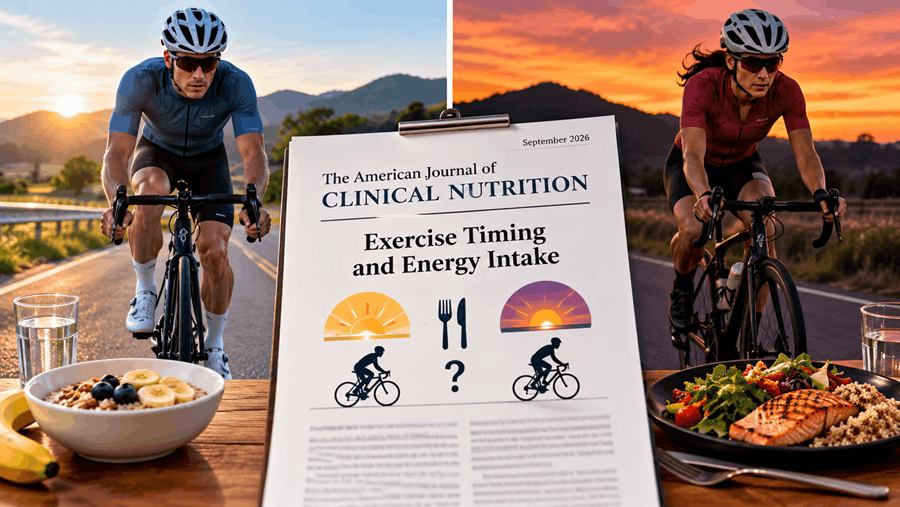
The trial, published in the September 2026 issue of the American Journal of Clinical Nutrition, set out to separate two things that usually get tangled together: when you exercise and whether you’ve eaten beforehand.[1]
Researchers used a randomized crossover design with 35 healthy young adults. “Crossover” means every participant did every condition, so each person served as their own comparison. That’s a much stronger setup than comparing one group of morning exercisers with a different group of evening exercisers.
The workout never changed: 30 minutes of moderate-intensity exercise every time. What changed was the timing and the fueling:
- Morning, after a 12-hour overnight fast
- Evening, after a 12-hour fast
- Evening, after a 6-hour fast (closer to real life: lunch, work, then train)
- A subgroup of 17 also did morning and evening sessions after a small pre-workout meal
One honest caveat for cyclists: the exercise in this trial was treadmill running, not riding. I’m covering it here because the findings may have implications beyond running, and because earlier cycling research has reported a similar pattern (more on that below).
The Main Finding
Compared with the morning session, evening exercise led to about 400 extra calories at the post-workout test meal and about 547 extra calories over the next 24 hours. Participants also reported more hunger, a stronger desire to eat, and less fullness after evening sessions, so the extra eating matched how they actually felt.[1]
That 547 figure is an average. The study’s confidence range ran from roughly 335 to 759 calories, so treat it as “several hundred calories,” not a precise number you’ll see on your own scale.
Why Pre-Fueling Didn’t Fix It
The results suggest that time of day had a stronger influence on post-exercise energy intake than pre-exercise fuel status. Eating beforehand changed some metabolic responses to exercise, but it did not eliminate the higher energy intake associated with evening exercise.
What the Cycling Research Says
A 2023 study in the journal Appetite had 16 men and women ride 30 minutes of steady cycling plus a 15-minute performance test, once at 10:30 a.m. and once at 6:30 p.m., after the same standardized meal. Post-ride intake at the next meal was about 150 calories higher after the evening ride, even though participants didn’t report feeling any hungrier beforehand. Performance on the test was the same at both times.[2]
That’s a smaller gap than the 2026 trial, and it only measured one meal, but the direction is the same: later sessions, more eating.
Why Riding Later Drives Up Appetite
Circadian Rhythm and Hunger Hormones
Hunger isn’t flat across the day. Controlled lab studies show that appetite follows an internal circadian rhythm, running lowest in the biological morning and highest in the evening, even when meals and sleep are held constant.[3] Hormones that drive hunger, such as ghrelin, and the signals that tell you you’re full also follow daily patterns.
A morning ride ends when your body clock is keeping hunger relatively quiet. An evening ride ends right as that natural appetite peak is building. The workout may therefore be landing on top of an appetite signal that is already rising.
Fatigue, Stress, and Evening Decisions
By the time an after-work ride is done, you’ve already made a full day’s worth of decisions and handled a full day’s worth of stress. You’re tired, dinner is late, and the easiest food is usually the least planned. None of that was measured in the 2026 study, but every rider who trains after work knows the scenario.
The “I Earned It” Mindset
A hard evening interval session feels like a license to eat. The trouble is that most of us overestimate what a ride burns and underestimate what a “reward” snack contains. Combine that with the circadian appetite rise and it’s easy to eat back the ride and then some.
Does It Matter for Your Training Goals?
Weight Management and Power-to-Weight
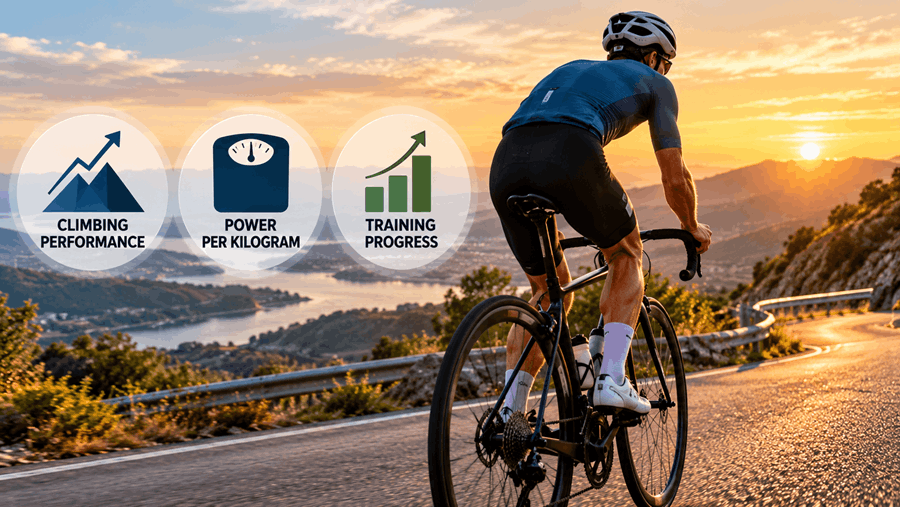
If you’re trying to improve your watts per kilogram for climbing or racing, a few hundred unplanned calories after every evening ride adds up across a training week. You don’t need to panic over it, but it’s worth knowing that timing may be quietly working against you.
Riders Trying to Fuel Recovery Properly
Not all extra eating is a problem. Many cyclists, especially Masters riders, under-fuel recovery and then wonder why their legs feel flat two days later. If you finish an evening ride and you’re genuinely hungry, that may be your body asking for what it needs. The goal is planned recovery fueling, not random grazing.
When Extra Calories Are a Good Thing
During big training blocks, high-volume base weeks, or a stage-race buildup, energy availability matters more than appetite control. Under-eating during heavy training raises the risk of poor adaptation, illness, and burnout. In those phases, a bigger evening appetite can actually make it easier to eat enough.
How to Ride in the Evening Without the Fridge Raid
Plan Your Post-Ride Dinner Before You Ride
Decide what dinner will be before you clip in. Prep it, thaw it, or have it ready to heat. When you walk in tired and hungry, the planned meal should be the easiest option in the kitchen.
Prioritize Protein and Fiber After the Ride
A recovery meal built around a solid protein portion, carbohydrates matched to how hard you rode, and vegetables or other high-fiber foods supports recovery and keeps you full longer than a bowl of cereal or a sleeve of crackers.
Hydrate First
Evening rides, especially warm ones, can leave you behind on fluids. Rehydrate after the ride before reaching for extra snacks. Replacing the fluid you lost is an important part of recovery and gives you a chance to settle into your planned post-ride meal.
As an Amazon affiliate we earn from qualified purchases
Set a Kitchen “Closing Time”
Pick a time after dinner when the kitchen is closed for the night. It removes the nightly negotiation with yourself and protects your sleep, which matters as much for recovery as anything you eat.
Coach James Tip
When I work with riders who can only train after work, the fix is rarely “eat less.” It’s “eat on purpose.” A planned afternoon snack two hours before the ride, a recovery meal that’s ready when you get home, and a firm cutoff afterward usually solves the late-night grazing without anyone feeling deprived.
Should You Switch to Morning Rides?
Pros and Cons
Morning rides: may be associated with lower post-exercise energy intake, the workout is done before the day gets in the way, and temperatures are often cooler in summer. The downside is less sleep for many riders, stiffer legs, and darkness for much of the fall and winter.
Performance Differences
Many riders find hard efforts feel better in the late afternoon or evening, and research on strength and power output generally shows a modest time-of-day advantage later in the day. That said, the 2023 cycling study above found no performance difference between its morning and evening sessions.[2] Your body also adapts to the time you usually train.
A Practical Hybrid
If your schedule allows, match your training time to when you feel and perform best. If hard efforts consistently feel better later in the day, evening threshold, VO2max, or race-simulation sessions may make sense. Easy endurance and recovery rides can often fit well in the morning. The goal is to balance workout quality, recovery, appetite, and a schedule you can maintain.
Frequently Asked Questions About Evening Rides and Appetite
Is it bad to ride at night?
No. Evening riding still delivers all the fitness and health benefits of training. You may simply be hungrier afterward, so plan your meals around it. Use good lights and reflective gear if you’re riding outdoors after dark.
How many calories should I eat after an evening ride?
It depends on how long and hard you rode and what your goals are. A good starting point is a normal dinner with a solid protein portion (roughly 20 to 40 grams) and carbohydrates scaled to the session: more after long or intense rides, less after an easy spin.
Does eating before an evening ride reduce hunger later?
Not necessarily. In the 2026 trial, eating before exercise changed how much fat participants burned during the session but did not significantly reduce subsequent energy intake compared with exercising fasted at the same time of day. Eat before an evening ride if it helps you train well, but don’t rely on pre-ride fueling alone to control how much you eat afterward.[1]
Are morning rides better for weight loss?
Morning exercise may reduce post-exercise energy intake compared with evening exercise, but that doesn’t necessarily mean morning rides produce greater long-term weight loss. Body weight is influenced by overall energy balance over time, and the studies discussed here were not designed to determine whether morning or evening training leads to greater long-term weight loss. Consistency with your training and nutrition remains more important than choosing a particular time of day.[1]
What’s the best snack after a late ride?
If dinner is more than an hour away, choose something with protein and some carbohydrate, such as Greek yogurt with fruit, a glass of milk, or a turkey sandwich. If dinner is close, drink water and wait for the meal.
References
- Effects of exercise timing and metabolic state on post-exercise energy intake and appetite: a randomized crossover trial. American Journal of Clinical Nutrition. 2026;124(3):101439. doi:10.1016/j.ajcnut.2026.101439. View study
- Effects of morning vs. evening exercise on appetite, energy intake, performance and metabolism, in lean males and females. Appetite. 2023;182:106422. View abstract
- Scheer FAJL, Morris CJ, Shea SA. The internal circadian clock increases hunger and appetite in the evening independent of food intake and other behaviors. Obesity. 2013;21(3):421-423. View abstract
James Hickman is a former USA Cycling Expert-level coach who has worked with cyclists at every level, from beginners to competitive racers. He served as a coach for the Leukemia & Lymphoma Society’s Team In Training program, helping riders prepare for and complete century events. A Masters-category racer himself, he competed and earned podium finishes in Southern California events and holds a Platinum finish at El Tour de Tucson, completing the 100 miles+ in under five hours.
Related Reading
 Fueling Cycling Nutrition Periodization: Fuel Each Training Phase for Maximum Performance |  FTP Why Your FTP Is Stuck (And Why Your AI Training App Can’t Fix It) |  Endurance Training |
Sponsored · Competitive Cyclist
We are an Amazon affiliate and earn from qualified purchases with no cost to you. This is for ANY product that you purchase through our links. We are also an affiliate for Competitive Cyclist and JensonUSA. This way we can provide you with competitive pricing and products.