

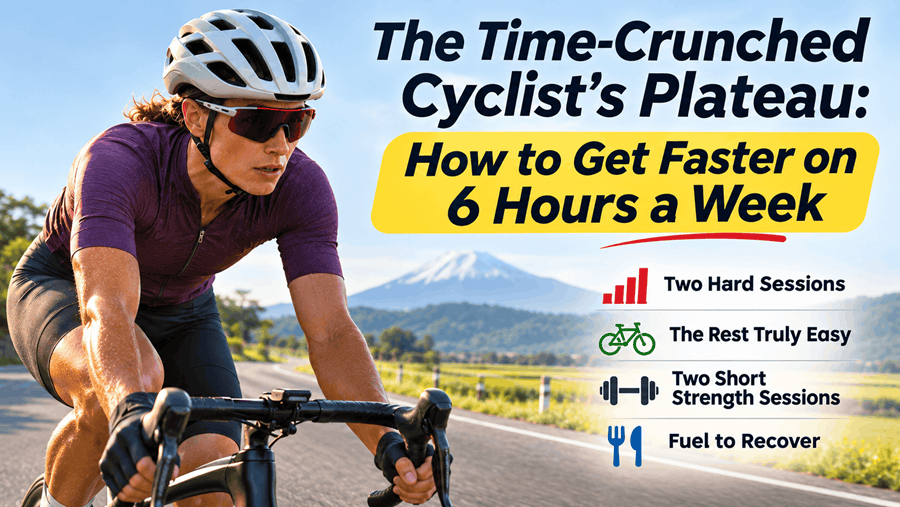
| Quick Answer: Most time-crunched cyclists plateau because they ride the same moderate intensity on every ride, under-recover, and under-fuel. Six hours a week is enough to keep improving if you make two sessions truly hard, keep everything else truly easy, add two short heavy strength sessions, and eat enough protein and carbohydrate to recover. Retest your FTP every six to eight weeks to confirm it’s working. |
By James Hickman, former USA Cycling Expert-level coach and Masters-category racer
Why Time-Crunched Cyclists Hit a Plateau
If you feel like there aren’t enough hours in the week to get faster, you’re in the majority. In a 2023 CTS survey of more than 1,000 amateur endurance athletes, limited training time was the number one factor keeping riders from their goals.
But limited time by itself is rarely what causes a plateau. What causes it is how that time gets spent. A rider with six hours tends to make every ride count by riding moderately hard every time: the same loop, the same group ride, the same “tempo-ish” effort. Your body adapts to that load within a few months, and then progress stops. Unstructured, same-intensity riding is one of the most common reasons enthusiasts with limited time stop improving.
The fix is not finding more hours. It’s giving the hours you have a clear job.
Make Hard Days Hard and Easy Days Easy
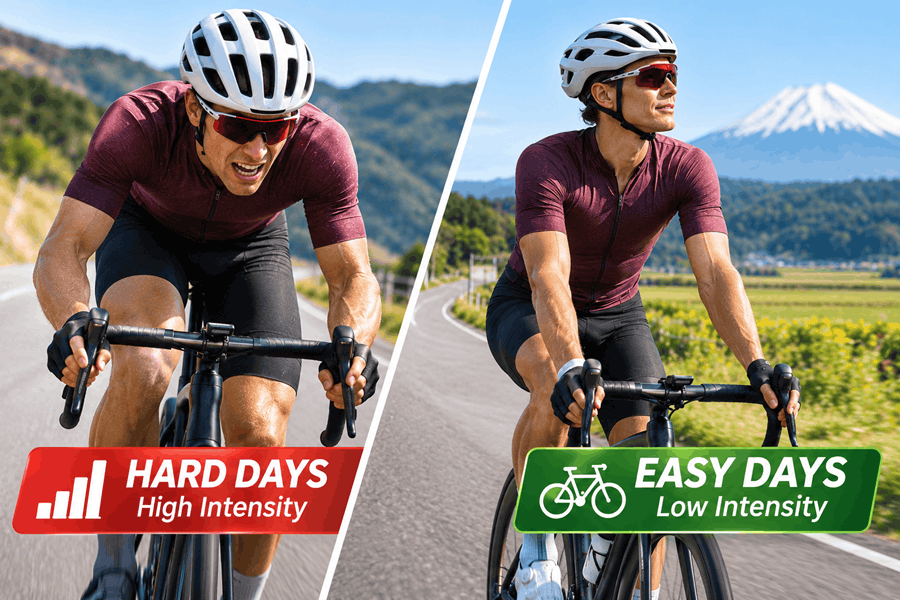
Sports scientist Stephen Seiler has said the biggest mistake amateur cyclists make is riding easy days too hard, which leaves hard days not hard enough. The research on low-volume training backs this up.
In a 2013 study in the Journal of Applied Physiology, trained cyclists completed two six-week blocks. One was polarized, at about 6.4 hours a week with roughly 80% easy and 20% hard. The other was threshold-focused, at about 7.5 hours a week with 57% easy and 43% moderate. Despite training about an hour less per week, the riders made bigger gains on the polarized block: peak power rose 8% versus 3%, and lactate threshold rose 9% versus 2%.
To be fair to the other side of the debate, sweet spot and threshold work also produce results, and reviews have concluded that the best intensity split for recreational riders is still unclear. The practical takeaway doesn’t depend on winning that argument, though. When your hours are limited, the middle ground of “kind of hard, every ride” is the least productive place to spend them.
Train Smarter, Not Just Harder
Keep your easy rides easy and track your effort
with the Wahoo TRACKR Heart Rate Monitor.
Use Short Intervals for Your Hardest Session
Interval structure matters too. A 10-week study comparing effort-matched short and long intervals had cyclists do two high-intensity sessions a week alongside easy riding. The short-interval group improved VO2max by 8.7%, compared with 2.6% for the long-interval group, and also improved more across 30-second, 5-minute, and 40-minute power tests.
A practical version is 30 seconds hard and 15 seconds easy, repeated 10 to 13 times, for two or three sets with a few easy minutes between sets. It fits inside an hour including warm-up and cool-down, which is exactly what a busy rider needs. If you train with power, base the targets on your current FTP. If you haven’t tested recently, start at functionalthresholdpower.com.
A Sample 6-Hour Training Week
This is a template, not a prescription. Move days around to fit your schedule, but keep at least one easy or rest day between the two hard sessions.
| Day | Session | Time |
| Monday | Rest | 0 |
| Tuesday | Short intervals: 2–3 sets of 10–13 x 30s hard / 15s easy | 60 min |
| Wednesday | Heavy strength session | 30 min |
| Thursday | Second quality ride: 4–5 x 4 min hard, or 2–3 x 12 min at threshold (alternate weeks) | 60 min |
| Friday | Easy spin, conversational pace | 30 min |
| Saturday | Long endurance ride, steady and easy | 2.5 hr |
| Sunday | Heavy strength session | 30 min |
That adds up to six hours. Notice how little of it is actually hard: maybe 40 to 60 minutes of true high-intensity work across the week. Everything else is either easy riding, which builds your aerobic base without adding much fatigue, or strength work. For more structured endurance plans, see endurancetrainingprogram.com.
Add Two Short Heavy Strength Sessions
Strength training is the first thing busy cyclists cut. In a study of 555 masters cyclists aged 35 and older, the main obstacles to lifting were fatigue from strength sessions and not having enough time for them.
That’s a mistake, because the evidence for heavy lifting in cyclists is strong. In research by Bent Rønnestad and colleagues, well-trained cyclists who added heavy strength training to their normal riding improved both the determinants of cycling performance and performance itself. A review by Rønnestad and Iñigo Mujika specifically recommends heavy loads, rather than light or explosive work, for improving cycling economy.
The programs in these studies were simple: four lower-body exercises, three sets of 4 to 10 repetitions, twice a week. That fits in 30 minutes. Squats or leg press, Romanian deadlifts, step-ups or split squats, and a single-leg calf or hip exercise cover the basics. Schedule lifting on easy days, not before a key interval session, so it doesn’t cost you quality on the bike. Full programs are at cyclingstrengthtraining.com.
Recover and Fuel Like the Training Matters
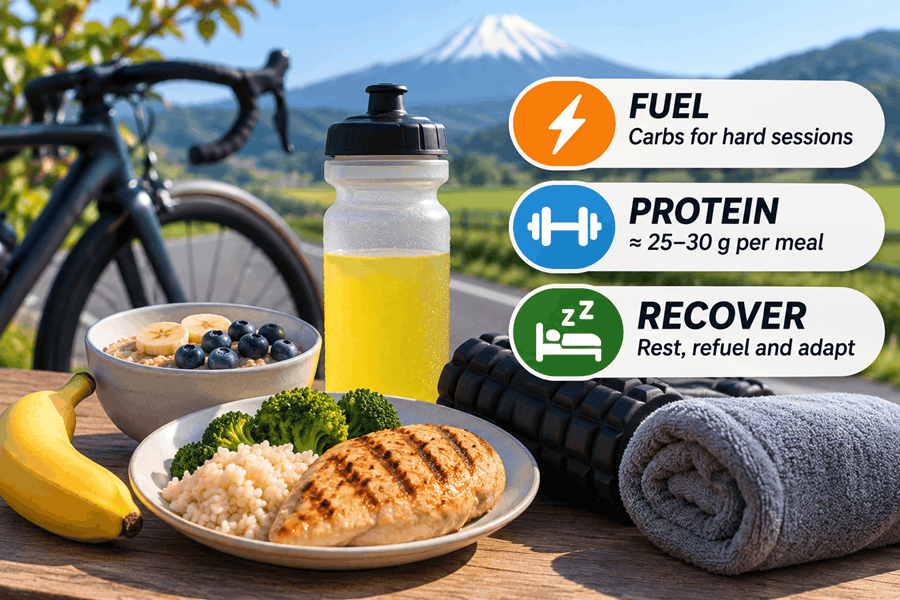
When legs feel heavy and motivation fades, most riders assume they’ve overtrained. Usually they haven’t. They’ve under-recovered. A loss of motivation to do hard intervals is often one of the earliest warning signs.
Fueling is the other half. Many plateaus turn out to be energy problems: riders show up to hard sessions under-fueled, the quality drops, and recovery suffers. This is common in time-crunched riders who squeeze a session in before work or skip lunch to ride at noon. Eat carbohydrate before your two hard sessions, and don’t try to lose weight on the days you do intervals.
Protein matters more than most cyclists think. The Gatorade Sports Science Institute recommends about 0.3 to 0.4 grams of protein per kilogram of body weight per meal, spread across four to five meals, with up to 0.5 g/kg right after endurance exercise. For a 75 kg rider, that’s roughly 25 to 30 grams per meal. For help planning carbohydrate around hard sessions and events, try the free Race & Ride Day Nutrition Planner.
Extra Notes for Masters Cyclists
Everything above applies with more force after 40. In research summarized by sports nutrition scientist Leigh Breen, masters triathletes had lower rates of muscle protein synthesis and tended to recover time-trial performance more slowly than younger athletes during three days of hard training. Breen suggests riders nearing 50 aim for the higher end of the range, around 0.4 g/kg per meal, four to five times a day.
Masters riders also benefit most from strength training, since muscle mass declines with age and the loss is greatest in fast-twitch fibers, the ones you rely on to sprint and climb. If you’re over 50 and only have time for one change, add the two strength sessions. If recovery is your limiter, consider running the plan in two-week cycles with only one hard ride in the second week.
How to Know It’s Working
Retest your FTP every six to eight weeks under the same conditions: same trainer or road, same time of day, similar rest beforehand. Also watch your easy rides. If your heart rate at a given easy power drifts lower over time, your aerobic base is improving even before your FTP shows it. If neither number moves after two test cycles, look first at sleep, fueling, and whether your easy days are actually easy before you add more intensity.
Frequently Asked Questions About Time-Crunched Cycling Training
Can you get faster on 6 hours a week of cycling?
Yes. In a 2013 study, trained cyclists averaging about 6.4 hours a week on a polarized plan improved peak power by 8% and lactate threshold by 9% in six weeks. The key is making two sessions truly hard and keeping the rest easy.
Why have I stopped getting faster on the bike?
The most common causes are riding the same intensity on every ride, not recovering enough between hard efforts, and under-fueling hard sessions. Your body adapts to a repeated training load and stops improving unless the stimulus changes.
Is polarized or sweet spot training better for time-crunched cyclists?
Controlled studies with trained cyclists have favored polarized training, but the best split for recreational riders isn’t settled. Both can work. The approach most likely to stall is riding moderately hard on every ride.
Should cyclists lift weights if they have limited time?
Yes. Research shows heavy strength training improves cycling performance and economy. Two 30-minute sessions a week of four lower-body exercises, three sets of 4 to 10 reps, is enough. Schedule them on easy days.
How much protein do masters cyclists need?
Aim for about 0.3 to 0.4 grams per kilogram of body weight per meal, four to five times a day. Riders nearing 50 and older should lean toward the higher end, around 0.4 g/kg per meal.
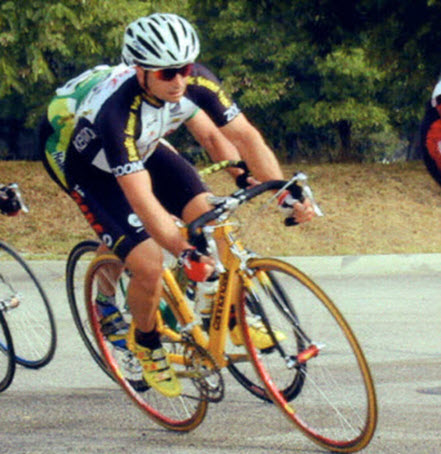
James Hickman is a former USA Cycling Expert-level coach who has worked with cyclists at every level, from beginners to competitive racers. He served as a coach for the Leukemia & Lymphoma Society’s Team In Training program, helping riders prepare for and complete century events. A Masters-category racer himself, he competed and earned podium finishes in Southern California events and holds a Platinum finish at El Tour de Tucson, completing the 100 miles+ in under five hours.
Related Reading
| Short on Time? Get the Time Crunch Fix A free app from Coach James that builds your training week around the hours you actually have.Get the Free App |
As an Amazon Associate, I earn from qualifying purchases. This site also participates in affiliate programs with Competitive Cyclist and JensonUSA. If you buy through links on this page, I may earn a commission at no extra cost to you.