

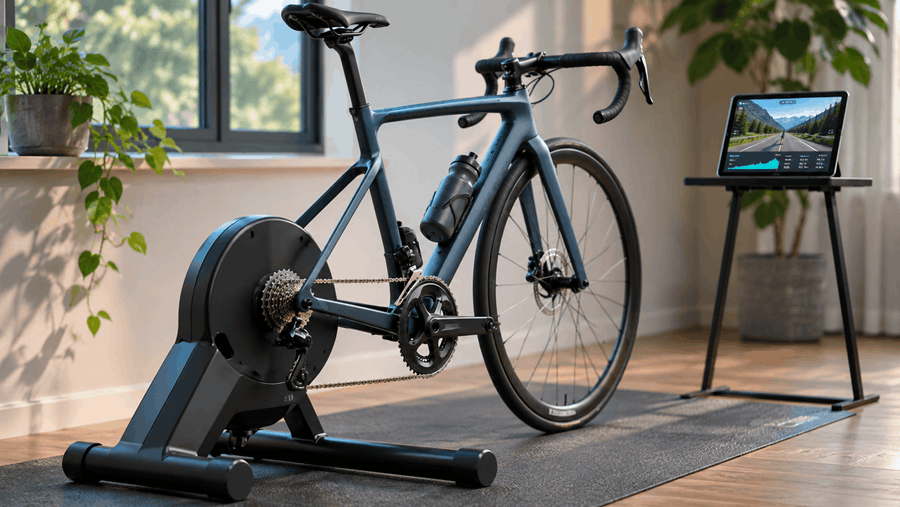
| Quick Answer: For most riders, the best Black Friday smart trainer is a discounted last-generation direct-drive model, not this year’s release. Smart trainers have reached a plateau, and the newest models mostly add Wi-Fi, faster data and easier setup. A previous-generation Tacx NEO 2T or Elite Justo, or the lightly updated Wahoo KICKR CORE 2, will train you just as well as the newest flagship. |
By James Hickman, former USA Cycling Expert-level coach and Masters-category racer
Every November I get the same question from riders: “Should I wait for the new one?” For years the answer was often yes. Each new generation of smart trainers brought real gains in accuracy, ride feel or noise, and buying the old model meant giving something up.
That has changed. When the specs that matter for training stay the same from one generation to the next, the smart buy is the outgoing model at a discount.
This guide covers what actually matters in a smart trainer for structured training, which last-generation models are worth buying, when it does make sense to buy the new one, and how to build out the rest of your pain cave.
Why Last Year’s Smart Trainer Is the Better Buy
The clearest example is Wahoo’s own lineup. Wahoo released the KICKR CORE 2 in September 2025, seven years after the original CORE. Maximum resistance, gradient simulation and claimed power accuracy stayed the same. Both trainers top out at 1,800 watts and are rated at ±2% accuracy.
What the CORE 2 added was built-in Wi-Fi, a Race Mode that sends power data up to 10 times per second instead of once, a sensor bridge that passes your heart rate strap through the trainer, color-coded LEDs and flat legs that are easier to assemble. Those are nice upgrades, but none of them changes a sweet spot interval or a threshold test. BikeRadar’s first ride summed it up fairly: the old CORE remains an excellent trainer.
The same pattern shows up across the market. Elite’s Justo 2 mainly adds a preinstalled 12-speed Shimano cassette and Wi-Fi. Garmin’s new Tacx Nēra, launched in October 2026, adds built-in movement and Wi-Fi at a lower price than the NEO 3M. When a new model arrives, retailers need to clear the old stock, and Black Friday is when they do it.
What Actually Matters in a Smart Trainer (A Coach’s View)
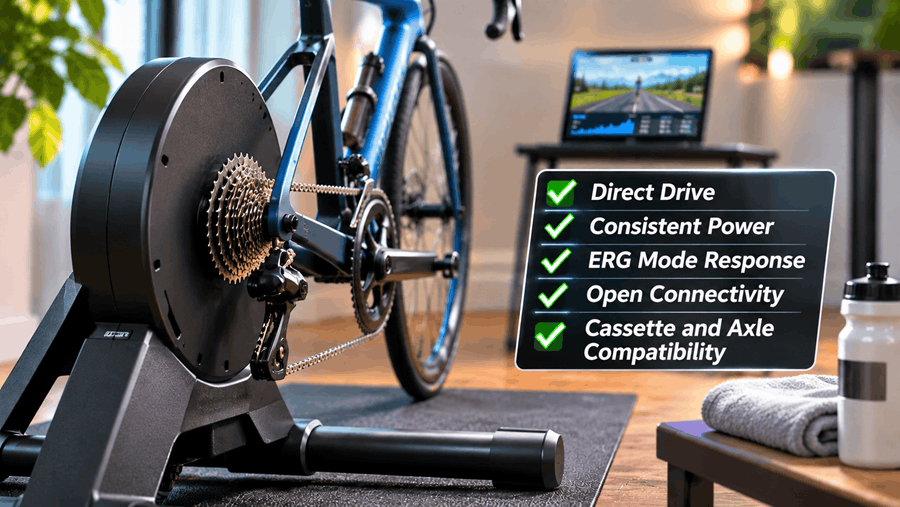
Spec sheets are long. For riders doing structured training, only a few lines on them make a real difference.
Direct drive. Take the rear wheel off and mount the bike straight to the trainer. Direct-drive trainers are quieter and more consistent, and they don’t wear out a tire or change with tire pressure. Wheel-on trainers still work, but every model in this guide is direct drive for a reason.
Consistent power, not perfect power. ±2% is plenty for training. What matters is that your trainer reads the same way every session, so your zones stay valid from week to week. Do your FTP tests on the same trainer you train on, and don’t expect it to match your outdoor power meter exactly.
ERG mode response. ERG mode holds your target wattage no matter your cadence or gear. A trainer that settles into each interval smoothly makes your workouts feel right. One that overshoots or lags makes them feel wrong. This matters more for most riders than maximum wattage.
Enough resistance. 1,800 watts covers almost everyone. Unless you are a strong sprinter doing low-cadence efforts, a higher maximum on the spec sheet won’t come into play.
Open connectivity. Look for both ANT+ FE-C and Bluetooth FTMS. With those, the trainer works with Zwift, TrainerRoad, MyWhoosh, TrainingPeaks Virtual and almost every other app. All of the trainers below have both.
Cassette and axle compatibility. Check whether a cassette is included, whether it matches your bike’s speed count, and whether the trainer fits your thru-axle or quick-release spacing. A cassette and the tools to fit it can be a surprise extra cost.
Wahoo KICKR CORE 2: Best Overall Value
This is the exception in this guide, and it proves the point. The original KICKR CORE has largely sold through, and the CORE 2 took its place. Underneath, it is the same trainer: the same 1,800-watt maximum, the same gradient simulation, the same ±2% accuracy and the same quiet, predictable ERG mode. Wahoo added Wi-Fi, Race Mode and easier setup without changing how it trains you, which is why the newer CORE 2 doesn’t carry a big premium. It’s the trainer I recommend to most riders. It works with Wahoo’s KICKR CLIMB and HEADWIND, and the Zwift Cog and Click version fits almost any bike regardless of drivetrain. If you come across a new original CORE at a clearance discount, it’s just as good for training. Check the Wahoo KICKR CORE 2 on Amazon
Tacx NEO 2T: Best Ride Feel
Garmin’s Tacx line now has the NEO 3M at the top and the new Nēra below it. That makes the NEO 2T the outgoing model, but it is still one of the best-feeling trainers ever built. It has a 2,200-watt maximum, up to 25% gradient simulation and power accuracy within 1%. Its motor-braked design also lets it simulate road surfaces and descents. Garmin now sells it as a Zwift Ready bundle with Zwift Cog and Click preinstalled. It’s heavy and needs a power outlet, but if ride feel is what you want, this is the deal to watch. Check the Tacx NEO 2T on Amazon
Elite Justo (Original): Best for Steep Climbs and Big Efforts
The original Justo simulates gradients up to 24% and handles up to 2,300 watts, with claimed accuracy better than ±1%. The Justo 2 adds a preinstalled cassette and Wi-Fi, but the trainer underneath works the same way. If you’re happy to fit your own cassette, a discounted first-generation Justo is a lot of trainer. Check the Elite Justo on Amazon
Elite Suito-T: Best Compact Option
Elite replaced the Suito with the Rivo, which has more resistance and new connectivity options. Reviews of the Rivo have been mixed: Cycling Plus called it wonderfully compact but said it falls short in several key areas. The Suito-T is compact, folds easily and is a proven training tool, so it’s a good choice for small spaces. Check whether the version you’re buying includes a cassette. Check the Elite Suito-T on Amazon
When the New Model Is Worth It
Buying last year’s model isn’t always right. Buy the current generation if any of these apply to you:
You race online. Race Mode on the KICKR CORE 2 and similar features on newer trainers respond faster during attacks and sprints.
Bluetooth keeps dropping out. If your pain cave is full of wireless signals or your device is far from the trainer, built-in Wi-Fi fixes the problem.
You want movement under the bike. Long indoor rides are easier on the saddle and back when the bike can move. Garmin’s Tacx Nēra puts forward, backward and side-to-side movement into the trainer itself, and costs well below the NEO 3M.
The discount gap closes. On Black Friday the new model is sometimes discounted almost as much as the old one. If the gap is small, buy the newer trainer for the longer firmware support.
Build Your Pain Cave: The Gear That Makes Indoor Training Work
The trainer is only part of the setup. In my experience coaching riders through the winter, the people who quit indoor training usually quit because they overheat, get bored or are uncomfortable. The trainer is rarely the problem. These are the pieces worth getting alongside it.
A strong fan. This is the most important accessory you can buy. Indoors there’s no airflow to cool you, so you overheat, your heart rate climbs and your power falls. Get a high-velocity floor fan or a dedicated training fan, and use two if you can. Shop training fans on Amazon
A trainer mat. It protects your floor from sweat, cuts vibration and noise, and keeps the trainer from creeping during sprints. Shop trainer mats on Amazon
A front wheel riser block. It levels the bike so your position matches the road. Without one, a direct-drive trainer can tilt you forward. Shop riser blocks on Amazon
A trainer desk. A rolling desk holds a laptop or tablet, your water bottle and a towel within reach. It makes long Zwift rides and structured sessions much easier to manage. Shop trainer desks on Amazon
A sweat guard and towel. Sweat corrodes headsets, bolts and handlebars. A cheap sweat guard saves expensive parts. Shop sweat guards on Amazon
The Coach’s Bottom Line
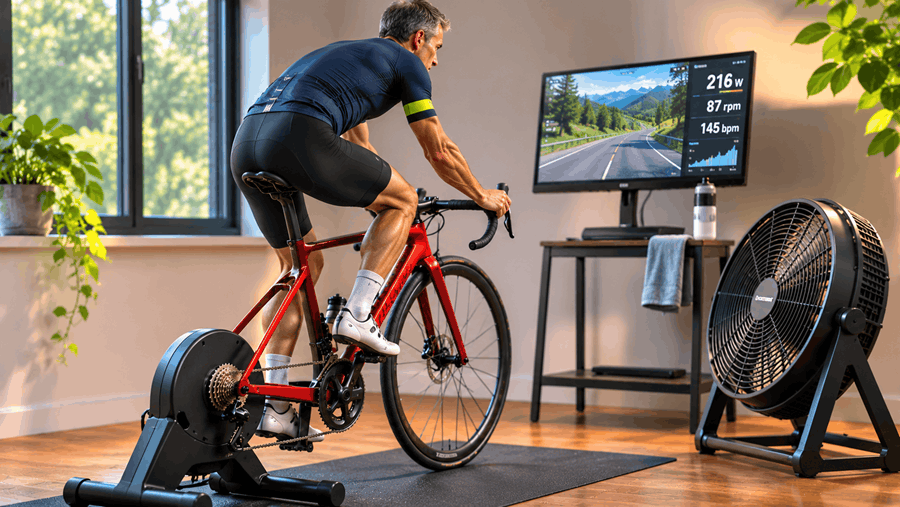
Your fitness this winter depends on how consistently you ride, not on which generation of trainer you ride. A last-generation direct-drive trainer, a good fan and a plan will get you to spring stronger than the newest trainer sitting unused in the corner. Buy last year’s model on sale and spend the savings on the fan and the rest of the setup.
Frequently Asked Questions About Smart Trainers
Is it worth buying an older smart trainer model?
Yes, for most riders. Recent generations have mainly added Wi-Fi, faster data and easier setup, while resistance, gradient and power accuracy have stayed largely the same. A discounted previous-generation direct-drive trainer gives you the same training benefit. If the older model has sold out, a lightly updated replacement such as the Wahoo KICKR CORE 2 trains the same way.
What is the difference between the Wahoo KICKR CORE and KICKR CORE 2?
The CORE 2 adds built-in Wi-Fi, Race Mode for faster power data, a sensor bridge for heart rate straps, status LEDs and easier-to-assemble legs. Maximum resistance (1,800 watts), gradient simulation and claimed accuracy (±2%) are the same on both.
Is a direct-drive trainer better than a wheel-on trainer?
For structured training, yes. Direct-drive trainers are quieter, more accurate and more consistent, and they don’t wear your rear tire or change with tire pressure.
How accurate does a smart trainer need to be for training?
±2% is accurate enough. Consistency matters more than absolute accuracy, so test your FTP on the same trainer you train on and keep your zones based on that trainer.
What accessories do I need for an indoor cycling setup?
The essentials are a strong fan, a trainer mat, a front wheel riser block, a sweat guard and a towel. A trainer desk is a worthwhile extra if you ride with a laptop or tablet.
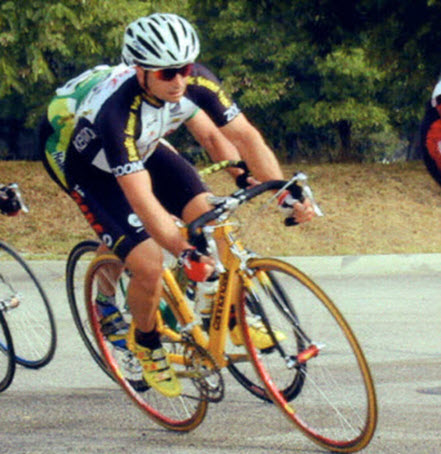
James Hickman is a former USA Cycling Expert-level coach who has worked with cyclists at every level, from beginners to competitive racers. He served as a coach for the Leukemia & Lymphoma Society’s Team In Training program, helping riders prepare for and complete century events. A Masters-category racer himself, he competed and earned podium finishes in Southern California events and holds a Platinum finish at El Tour de Tucson, completing the 100 miles+ in under five hours.
Related Reading
 Gear |  Gear Best Fall and Winter Cycling Gear: What to Buy Before the Cold Hits |  Training |
Affiliate Disclosure: As an Amazon Associate I earn from qualifying purchases. This article also contains affiliate links to Competitive Cyclist and JensonUSA. If you buy through these links, I may earn a commission at no extra cost to you.