


| Quick Answer: Your FTP is stuck because you have been training at threshold instead of raising the ceiling above it. FTP is limited by your VO2max, the size of your aerobic base, and how well you fuel — not by how many threshold intervals you complete. Adaptive training apps optimize toward population averages, which works well until you approach your own ceiling. At that point the app stops being a coach and starts being a mirror. |
By James Hickman, former USA Cycling Expert-level coach and Masters-category racer
Amazon Affiliate I earn from qualified purchases
You did everything the plan asked. Eight months of structured work, near-perfect compliance, every interval completed on target. Then your training app revised your FTP — downward.
It feels like a betrayal, and the frustration is specific. This is not the old plateau where you knew, privately, that you had been coasting. You were not coasting. The software was supposed to be adaptive. It adapted you into a lower number.
Here is what almost nobody tells you. Your FTP is not stuck because you failed to work hard enough. It is stuck for two separate reasons that get tangled together: you have been training at threshold instead of raising the ceiling above it, and the tool measuring you can only describe the riding you already did. Let’s take those apart.
First, Define What “Stuck” Actually Means
Riders use one phrase for three different problems, and the fixes are not the same.
Problem one: your tested FTP genuinely has not moved in six months or more. This is a training design problem, and it is the most common.
Problem two: your FTP has not been tested — it has been estimated by software, and the estimate went down. This is a measurement problem, and it may have nothing to do with your fitness.
Problem three: your FTP is flat but you are getting dropped later in rides than you used to, or holding on better in the fourth hour. This is not a plateau at all. That is progress your FTP number is too crude to capture.
Before you change a single workout, work out which one you have. Most riders who write to me assuming they have problem one actually have problem two or three.
What Your Training App Can See — And What It Cannot
Adaptive platforms are genuinely useful. They solved a real problem: most amateurs cannot design progressive overload for themselves, and structured software beats riding the same tempo loop four times a week by an enormous margin. That is not in dispute.
But understand what these systems are doing. They pattern-match your data against a very large population of other riders, then prescribe what worked for the riders you most resemble. That is powerful when you are far from your ceiling, because most riders far from their ceiling need the same handful of things. It becomes progressively less useful as you close in on your own limits, because at that point what you need is increasingly specific to you. Coaches see this exact pattern in their inbox — riders arrive saying the app stopped producing gains, and the common thread is that they had gotten close enough to their ceiling that population averages no longer described them.

If you want to read your own data instead of trusting an average, Training and Racing with a Power Meter is still the book that teaches you how.
The second point matters even more. AI FTP detection estimates your threshold from the riding you have already done. If your training never touches the intensities that would reveal a higher ceiling, the model cannot find one. It is not being pessimistic. It is being accurate about a rut. A lowered estimate is often the software correctly describing what you fed it.
And if you have been asking a general-purpose AI chatbot for training advice, know that it is reasoning from the average of everything published about cycling training. That is the internet’s consensus, not necessarily the correct answer, and definitely not the correct answer for your physiology, your schedule, and your history.
An app can tell you what you did. It cannot tell you what you are missing. Everything below is what it is missing.
Reason 1: You Are Training the Number, Not the Ceiling Above It
This is the single most useful idea in this article, so read it twice.
Your functional threshold power sits underneath your VO2max. Threshold is the floor; VO2max is the ceiling. If you spend season after season grinding threshold and sweet spot intervals, you are pushing the floor up toward a ceiling that has not moved. Eventually the gap closes and the floor stops rising, no matter how much work you pile on. This is exactly why sweet spot training produces beautiful gains for twelve to eighteen months and then quietly quits on people.
The fix is to raise the ceiling: three to five minute efforts at roughly 106 to 120 percent of FTP, run as a dedicated block, not sprinkled one session at a time into an otherwise threshold-heavy plan. Four to six weeks of genuine VO2max work, then return to threshold and watch what the floor does with the extra room above it.
Most adaptive plans do include VO2max sessions. What they rarely do is give you a concentrated block of them, because concentrated blocks feel bad in the short term and software optimized around completion rates does not love workouts you are likely to fail.
Reason 2: Your Aerobic Base Is Too Small to Hold a Higher Threshold
The other direction of the same problem. Threshold is supported from below by aerobic capacity — mitochondrial density, capillary networks, lactate clearance. A small base puts a hard cap on how high threshold can climb, and no volume of intervals will move it.
The practical failure here is what I call middle-zone sludge. Easy rides drift up into Zone 3 because it feels productive. Hard rides drift down into Zone 3 because you are carrying fatigue from the easy rides. Everything collapses into a moderately uncomfortable middle that builds very little of anything.
A word of caution on the standard advice here. The 80/20 rule gets repeated as though it were a recipe, but Stephen Seiler — whose research popularized it — has been explicit that intensity distribution is a principle, not a prescription. His 2024 paper in Applied Physiology, Nutrition, and Metabolism argues that training age, weekly volume, life stress, and where you are in the season all determine what your distribution should look like in any given block. A rider on six hours a week and a rider on sixteen should not be running the same ratio. Make your easy rides genuinely easy and your hard rides genuinely hard, and let the percentages follow your volume.
Reason 3: You Are Testing on Empty
This one is invisible in your training file, which is precisely why it goes unfixed for years.
If you are riding three and four hour endurance rides on 40 grams of carbohydrate per hour, and then running an FTP test at the end of a block built on that intake, you are not measuring a fitness ceiling. You are measuring a fueling failure and giving it a number.
For most amateurs riding three to four hours at sub-threshold intensity, 60 to 90 grams per hour is the working range. Dr. Sam Impey, who works with Tom Pidcock and Filippo Ganna, has publicly revised his own recommendations downward for amateurs, precisely because the professional peloton’s 120 grams per hour headline was being copied by riders who neither need it nor can absorb it. A 2025 review in Sports Medicine found that the existing evidence does not directly support a performance benefit from intakes at or above 100 grams per hour. Above 60 grams, gut training is your actual limiter — you have to build that tolerance deliberately over weeks.
Fix the fueling for one full block before you conclude anything about your ceiling.
Reason 4: The Number Is Fine — Your Durability Isn’t
FTP is measured fresh. Races, gran fondos, and hard group rides are decided on what you have left at hour three.
Durability — your ability to hold power after significant work has already been done — is the metric the sport is moving toward, and it is where a lot of riders are quietly improving while their FTP sits still. If your twenty-minute power is unchanged but you are surviving climbs that used to shed you, your training is working and your test protocol is simply too blunt to show it.
Test it directly: repeat a familiar interval set after two and a half hours of endurance riding, and compare it to the same set done fresh. The gap between those two numbers is the honest measure of your fitness, and it is a target you can train.
The Four-Week Plateau Audit
Critique is cheap. Here is the protocol.
Week one — diagnose. Pull your season’s files. Not all of them: the goal events and the sessions that went wrong. Identify where you actually lost time, and be specific about it. “I need to be fitter” is not a limiter. “I lost forty-five seconds per kilometer on climbs over eight percent against riders I matched on the flat” is a limiter. Cross-reference your fueling notes against how long and how hard those events actually were
Weeks two through four — one limiter, one block. Pick the single biggest limiter and build a block around it. One. Not three. If the limiter is your ceiling, run VO2max. If it is your base, run genuine low-intensity volume and defend it against drift. If it is fueling, fix the intake first and retest everything afterward.
Then re-enter your app’s plan and let it adapt to a rider it has not seen before.
Consistency built your plateau. Only a change in stimulus breaks it. The riders who stay fast into their forties and fifties are not the genetically gifted ones — they are the ones who changed their training when it stopped working, instead of repeating what used to work and losing a few watts every year.
References
Seiler, S. et al. (2024). It’s about the long game, not epic workouts: unpacking HIIT for endurance athletes. Applied Physiology, Nutrition, and Metabolism.
Wilson, P.B. (2025). A narrative review of the high-carbohydrate fueling revolution in the professional peloton. Sports Medicine.
Jeukendrup, A. — research on multiple transportable carbohydrates and glucose-fructose oxidation rates.
Impey, S. — public guidance on amateur versus professional carbohydrate intake, as reported in 2026 coverage of World Tour nutrition practice.
Frequently Asked Questions About FTP Plateaus
Why did my AI training app lower my FTP?
Because AI FTP detection estimates your threshold from the riding you have already done. If your recent training has not included efforts near or above threshold, the model has no evidence of a higher ceiling and revises downward. In most cases this reflects a change in what you have been riding, not a loss of fitness. Ride a hard, well-fueled effort and the estimate typically recovers.
How long does it take to break through an FTP plateau?
Plan on four to eight weeks. A concentrated block aimed at one limiter needs three to four weeks of loading plus a recovery week before the adaptation shows up in a test. Riders who change something every ten days never stay with any stimulus long enough for it to work.
Should I stop using TrainerRoad or Zwift if my FTP is stuck?
No. The platform is not the problem — the diagnosis is. Run a targeted block outside the standard plan to address your specific limiter, then return to the app. Structured software remains far better than unstructured riding for the other forty-eight weeks of the year.
Can I raise my FTP without doing VO2max intervals?
Early in your development, yes — threshold and sweet spot work alone will move FTP substantially for the first year or two. Once that stops working, the ceiling above threshold has become the limiter, and raising it requires efforts in the three to five minute range at roughly 106 to 120 percent of FTP.
Is a plateau after 40 just age?
Rarely. VO2max declines slowly in riders who keep training, and threshold power, efficiency, and durability decline more slowly still. What changes most after 40 is recovery — hard sessions need more time between them, often up to 72 hours. Masters riders who plateau are usually training too hard too often, not too little.
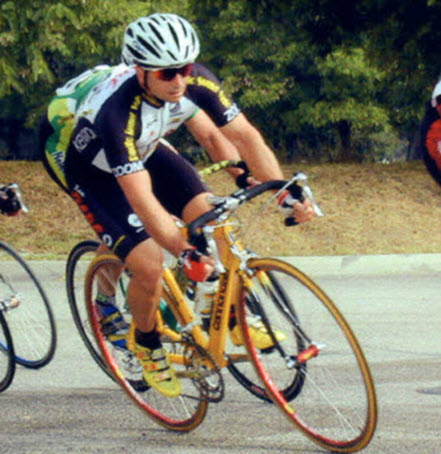
James Hickman is a former USA Cycling Expert-level coach who has worked with cyclists at every level, from beginners to competitive racers. He served as a coach for the Leukemia & Lymphoma Society’s Team In Training program, helping riders prepare for and complete century events. A Masters-category racer himself, he competed and earned podium finishes in Southern California events and holds a Platinum finish at El Tour de Tucson, completing the 100 miles+ in under five hours.
Related Reading
 Training Zone 2 Training vs. Sweet Spot: The 2026 Cycling Debate Guide |  FTP |  Nutrition Carbs Per Hour: How Much Should You Actually Eat on the Bike? |
Not sure which limiter is holding your FTP back? Answer seven quick questions and get a personalized FTP roadmap built around your equipment, your schedule, and your biggest limiter.
Sponsored · Competitive Cyclist
Disclosure: We are an Amazon affiliate and earn from qualified Amazon purchases with no cost to you. This is for ANY product that you purchase through our links. We are also an affiliate for Competitive Cyclist and JensonUSA. This way we can provide you with competitive pricing and products.