


| Quick Answer: Maximum heart rate falls with age whether you train or not, so a lower peak number doesn’t mean you’re losing fitness. A November 2026 study found fit men in their late 50s covered the same distance as fit men in their mid-20s in a repeated-sprint time trial, despite a peak heart rate about 15 bpm lower. Judge your fitness by power, by how well you hold power across repeated efforts, and by heart-rate zones built from your threshold rather than an age formula. |
By James Hickman, former USA Cycling Expert-level coach and Masters-category racer
You used to see 185 on your head unit during a hard climb. Now 170 feels like the ceiling, and you’re wondering whether the engine is wearing out. For most masters riders, the honest answer is no. Your heart’s top speed is a poor stand-in for how fast you actually ride, and new research makes that point well.
This article explains why max heart rate drops, what the new study found, and the three things I’d have any masters rider do about it: track power decay across repeated efforts, rebuild your heart-rate and power zones from threshold tests, and pace in a way that plays to your strengths.
Why Your Max Heart Rate Is Falling
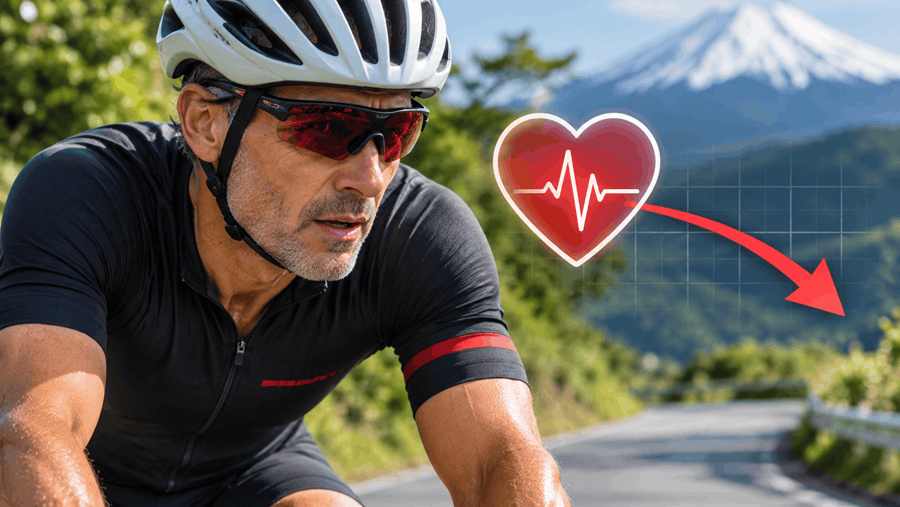
Max heart rate declines with age in nearly everyone. The most widely used prediction, from a 2001 meta-analysis by Tanaka, Monahan and Seals, is 208 − 0.7 × age. The researchers found the age trend was the same for men and women and wasn’t changed by how active people were. Training doesn’t stop it. A longitudinal study of 135 masters runners tested about 8.5 years apart found max heart rate dropped regardless of age group or sex, and the drop wasn’t linked to training volume.

Keep two things in mind. First, a formula is only an estimate for a population. The Tanaka equation has a standard error of around 10 bpm, so plenty of riders sit well above or below their predicted number. Second, max heart rate is just one input to aerobic performance. Stroke volume, blood volume, muscle oxygen use, threshold power and pedaling efficiency all matter, and several of them respond to training far better than max heart rate does.
One safety note: a gradual decline over years is normal. A sudden drop, an unusually high or erratic heart rate, chest discomfort, dizziness or unusual breathlessness is not, and it’s a reason to see a doctor before your next hard ride. Some medications, including beta-blockers, also lower heart rate. If you take one, ask your doctor how to set training intensities.
What the New Research Shows
In a study published November 19, 2026 in Pflügers Archiv, researchers at Charles Sturt University compared three groups of healthy men:
- 11 older trained men, average age 57.5
- 8 young trained men, average age 26.3
- 9 young untrained men, average age 24.8
Each rode a 25-minute self-paced time trial made of five blocks: 4.5 minutes at a lower intensity of their own choosing, then a 30-second all-out sprint. The goal was to do as much work as possible.
The older men covered 12.87 km, against 12.46 km for the young trained men and 11.48 km for the young untrained men. The older and young trained groups weren’t statistically different. Peak heart rate told a different story: 164 bpm for the older men versus 179 bpm for the young trained men.
How the older men got there matters most for your riding. The young trained men were the stronger sprinters. The older men made up the difference between sprints: they averaged 165 watts in the lower-intensity sections against 138 watts for the young trained group, a gap that wasn’t statistically significant. Their sprint power was also the most consistent from sprint to sprint, with a coefficient of variation of 7.8%, compared with 12.2% for the young trained men and 28.4% for the untrained men.
What this study can’t tell you: it’s a small snapshot, not a training study. “Trained” meant exercising at least three times a week for six months, so these weren’t necessarily cyclists, and training volume wasn’t recorded. There was no older untrained group, so it can’t separate the effects of age from training. And men still training hard at 57 are a self-selected group. Treat it as evidence that a lower heart-rate ceiling and strong performance can coexist, not as proof that training caused it.
How to Track Power Decay Across Repeated Efforts
If peak heart rate isn’t your report card, these three measures should be. All of them work with a power meter or smart trainer, and the first two need nothing more than a calculator.
1. A repeated-effort test with a percentage decrement score. Pick a set you can repeat every 4 to 6 weeks under similar conditions. A simple version that mirrors the study: after a thorough warm-up, ride 5 × 30-second all-out efforts with 4.5 minutes of steady riding between them, at a fixed power you can hold, such as your endurance or tempo zone. Record average power for each sprint.
Then calculate the percentage decrement score, the fatigue measure Glaister and colleagues found most valid and reliable for repeated maximal cycling efforts:
Decrement (%) = [1 − (total sprint power ÷ (best sprint × number of sprints))] × 100
Example: sprints of 900, 880, 850, 830 and 820 watts total 4,280 watts. Best sprint × 5 = 4,500. 4,280 ÷ 4,500 = 0.951, so the decrement is about 4.9%. There are no published norms for masters cyclists, so compare yourself only with yourself. A falling decrement at the same or higher sprint power means you’re holding quality better. Also track the steady-section power: if you can hold more between sprints without the decrement rising, that’s exactly the strength the older riders in the study showed.
2. Durability: your power after accumulated work. Racing and long group rides are decided late, when you’re tired. Researchers now call the ability to hold power after hours of work “durability,” and a 2025 systematic review found power declines of 10–20% after prior high-intensity work. Lower-intensity work of the same volume caused smaller drops. One home-friendly protocol, used in a study of competitive amateurs: ride at 70–80% of your 20-minute power until you’ve done 1,000 kJ of work, then do a 5-minute and a 20-minute best effort. Compare those numbers with your fresh best efforts. The smaller the gap, the more durable you are.
3. Aerobic decoupling (Pw:HR). This one uses heart rate the right way: as a ratio against power, not as a ceiling. On a steady endurance ride, split the steady part in half, divide average power by average heart rate for each half, and compare. Joe Friel’s guideline is decoupling of 5% or less on steady aerobic rides. Example: 200 W at 140 bpm in the first half and 200 W at 147 bpm in the second gives about 4.8% decoupling. Heat, dehydration and poor fueling all push the number up, so compare like-for-like rides. TrainingPeaks calculates this automatically, along with Efficiency Factor (normalized power ÷ heart rate). A rising Efficiency Factor over several weeks means more watts per heartbeat, which is real fitness improvement whatever your max heart rate does.
Coach James’s Holiday Picks
Stocking Stuffers Cyclists Actually Use
Small gifts that earn their place in the jersey pocket and the toolbox, not the junk drawer. picked by a former USA Cycling coach.
See the Stocking Stuffers List →
As an Amazon Associate I earn from qualifying purchases.
How to Recalibrate Your Heart-Rate Zones
If your heart-rate zones come from 220 minus your age, or from a max you hit ten years ago, they’re almost certainly wrong. The fix is to base them on lactate threshold heart rate (LTHR), which you can measure in the field, and not on max heart rate. A threshold-based system also takes care of the falling max. If your ceiling drops, your threshold heart rate usually drops with it, and a retest moves your zones accordingly.
The test: Joe Friel’s protocol is a solo 30-minute time trial, ridden as a race effort. Press the lap button at 10 minutes. Your average heart rate for the final 20 minutes is your LTHR. Pace it evenly. Friel notes that most riders go out too hard and fade, which skews the result. Ride it alone, not in a group or race.
Friel’s cycling heart-rate zones as a percentage of LTHR:
| Zone | % of LTHR |
| Zone 1 – Recovery | Below 81% |
| Zone 2 – Aerobic | 81–89% |
| Zone 3 – Tempo | 90–93% |
| Zone 4 – Sub-threshold | 94–99% |
| Zone 5a – Threshold | 100–102% |
| Zone 5b – Aerobic capacity | 103–106% |
| Zone 5c – Anaerobic capacity | Above 106% |
If you prefer max-based zones, measure your max instead of predicting it: it’s usually the highest number you see at the end of a hard, well-rested race or all-out climb. Don’t chase a max-heart-rate test if you have any known heart condition or symptoms without your doctor’s clearance. Honestly, for most riders it’s simpler to skip max heart rate entirely and use LTHR.
Remember the lag. Heart rate responds slowly at the start of an effort and drifts upward late in long rides, especially in heat. Use heart-rate zones for steady endurance work and for checking decoupling. Don’t use them to pace short intervals or sprints.
How to Recalibrate Your Power Zones
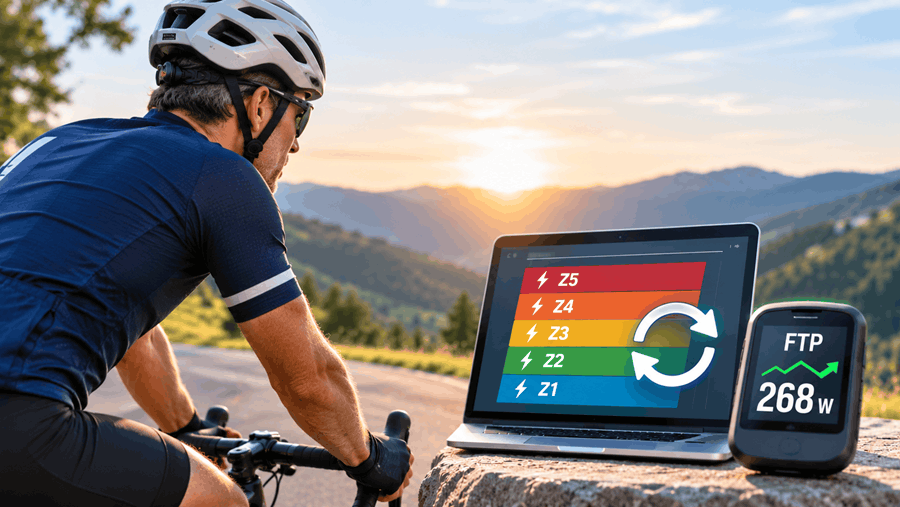
Power zones come from Functional Threshold Power (FTP), and they aren’t affected by your heart-rate ceiling at all. That’s one reason I push masters riders toward power. The same 30-minute test gives you both numbers: Friel uses average power for the full 30 minutes as an approximate FTP, alongside the LTHR from the last 20 minutes. A 20-minute test (FTP ≈ 95% of 20-minute power) or a ramp test also works. Pick one protocol and stick with it, because switching protocols changes the number.
The most widely used system is Andy Coggan’s seven power levels, with matching heart-rate ranges as a percentage of threshold heart rate:
| Level | % of FTP | % of threshold HR |
| 1 – Active Recovery | 55% or less | 68% or less |
| 2 – Endurance | 56–75% | 69–83% |
| 3 – Tempo | 76–90% | 84–94% |
| 4 – Lactate Threshold | 91–105% | 95–105% |
| 5 – VO2max | 106–120% | Above 106% |
| 6 – Anaerobic Capacity | 121–150% | N/A |
| 7 – Neuromuscular Power | Maximal | N/A |
How often to retest: the common guideline is every 4 to 6 weeks, at the start of a training block, and always when you’re rested. For masters riders I’d put the test right after a recovery week. Testing on tired legs gives you a falsely low FTP, and you’ll spend the next block training too easy. Also retest after illness, injury or a long break.
Use the two systems together. If your FTP holds steady or rises while your threshold heart rate creeps down, you’re producing the same watts with fewer beats. That’s the pattern the older riders in the study showed, and it’s not a decline.
Pacing Strategies That Play to a Masters Rider’s Strengths
The study’s most useful lesson isn’t about heart rate. The older men didn’t win on sprints. They won by riding stronger between efforts and fading less. Here’s how to apply that on the road.
Time trials: ride close to even, not rigidly even. In a 20 km time-trial study, even pacing produced less physiological disruption and lower perceived effort than self-paced or variable pacing at the same total work. But when researchers forced cyclists to hold a perfectly fixed power equal to their best effort, 9 of 15 couldn’t finish. The practical takeaway: start at or just below target power for the first few minutes, settle into a steady effort, allow small swings for hills and wind, and empty the tank in the final stretch. Pace by power and feel. Heart rate lags too much to steer a time trial. For target numbers, see how to pace a 40K time trial using your FTP.
Short efforts: a brief fast start, then settle. For short, very hard efforts such as a 4 km pursuit or a short prologue, evidence suggests a hard start of roughly 10–15 seconds followed by a quick move to steady pace can improve the result.
Group rides and races: ration your matches. If you can’t out-sprint younger riders, don’t spend energy following every surge. Sit in, hold strong steady power on the sections that matter, and save your one or two real efforts for where they’ll count: the final climb, the key crosswind section, or a late move. Your repeated-effort test tells you how many good efforts you’ve really got.
Train the in-between. Workouts that mix hard surges with strong riding between them build exactly this skill. Examples are over-unders, or tempo with short bursts like the study protocol. Track the power you can hold in the “rest” sections over the weeks, not just your peak numbers.
The Bottom Line
A falling max heart rate is a normal part of aging, not a fitness verdict. Measure what actually decides races: threshold power, how well you hold power across repeated efforts, how durable you are late in a ride, and how many watts you get per heartbeat. Rebuild your zones from threshold tests every training block, and pace to win the in-between. Those are the numbers worth watching after 50.
Frequently Asked Questions About Max Heart Rate and Aging
Does a lower max heart rate mean I’m losing fitness?
Not by itself. Max heart rate declines with age whether you train or not. Fitness is better judged by threshold power, power held across repeated efforts, and power relative to heart rate on steady rides.
Can training stop my max heart rate from dropping?
Not reliably. Large studies found age-related max heart rate decline wasn’t influenced by activity level, and a longitudinal study of masters runners found the drop wasn’t linked to training volume. Training does help maintain other parts of performance.
Should I use 220 minus age to set my heart-rate zones?
No. Age formulas can be off by 10 bpm or more for an individual. Base your zones on lactate threshold heart rate from a 30-minute solo time trial, using your average heart rate for the last 20 minutes.
How do I measure power decay across repeated efforts?
Do a repeatable set, such as 5 × 30-second sprints with 4.5 minutes of steady riding between them, and calculate the percentage decrement score: [1 − (total sprint power ÷ (best sprint × number of sprints))] × 100. A lower score over time means you’re holding quality better.
How often should masters cyclists retest FTP and threshold heart rate?
Every 4 to 6 weeks, at the start of a training block and after a recovery week so you test rested. Retest after illness, injury or a long break, and use the same test protocol each time.
When should a change in heart rate worry me?
A gradual decline over years is normal. See a doctor about a sudden drop, an unusually high or erratic heart rate, chest discomfort, dizziness or unusual breathlessness, and before maximal testing if you have a known heart condition.
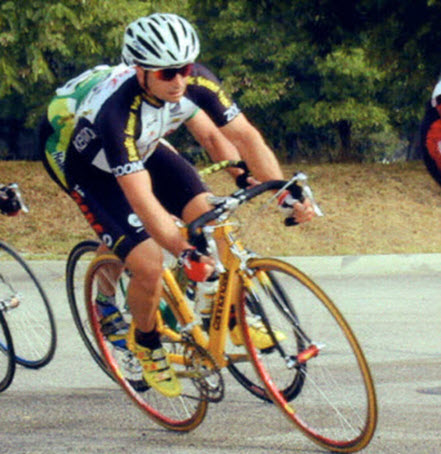
James Hickman is a former USA Cycling Expert-level coach who has worked with cyclists at every level, from beginners to competitive racers. He served as a coach for the Leukemia & Lymphoma Society’s Team In Training program, helping riders prepare for and complete century events. A Masters-category racer himself, he competed and earned podium finishes in Southern California events and holds a Platinum finish at El Tour de Tucson, completing the 100 miles+ in under five hours.
Related Reading
 Training |  Training |  Training |
Sponsored · Competitive Cyclist
Keeping a classic on the road?
Tools, kit and ride gear for vintage steel and modern bikes alike. Competitive Cyclist runs new sales every week.
As an Amazon Associate, I earn from qualifying purchases. I’m also an affiliate of Competitive Cyclist and JensonUSA and may earn a commission if you buy through links on this page, at no extra cost to you.