

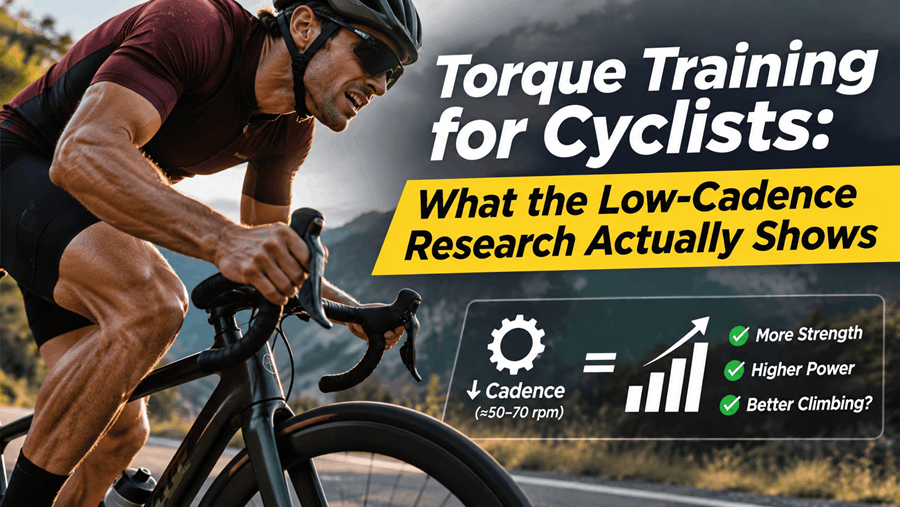
| Quick Answer: Torque training means riding intervals at a low cadence, usually 50–70 rpm, so each pedal stroke takes more force. A 2024 study of well-trained cyclists found that doing the same intervals at 50–70 rpm instead of above 80 rpm nearly doubled VO2max gains over eight weeks (8.7% vs 4.6%). Older research is mixed, so treat it as a useful tool to use once or twice a week, not a magic fix. |
By James Hickman, former USA Cycling Expert-level coach and Masters-category racer
If you’ve been on cycling social media lately, you’ve probably seen the claim: “Low cadence intervals double your VO2max gains.” Podcasts and short videos are using it to say the old-school coaches were right all along about big-gear work.
I coached for years, and I’ve used low-cadence work with my own riders. So I was glad to see new research on it. But the headline version leaves a lot out. Here’s what the study found, what the rest of the research says, and how to use torque training this winter without wrecking your knees.
What Is Torque Training?
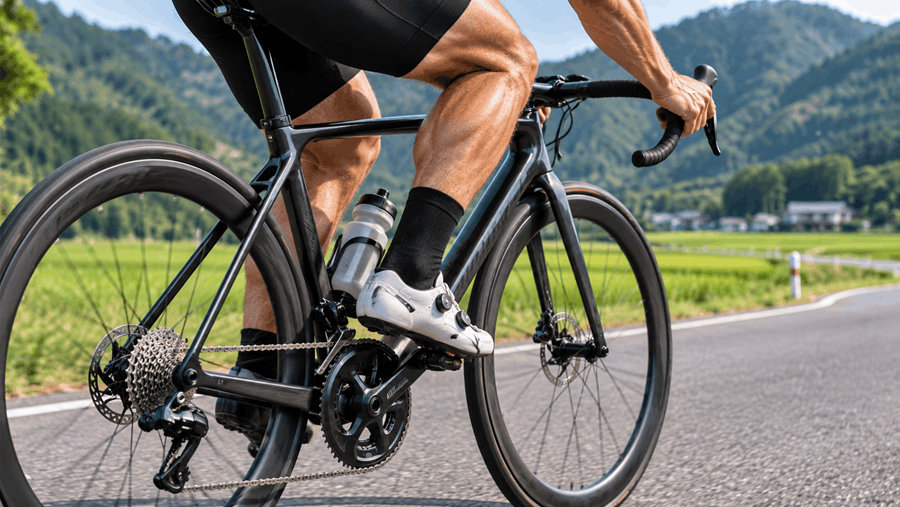
Power on the bike is torque multiplied by cadence. You can make 250 watts by spinning a light gear fast or by pushing a big gear slowly. Torque training deliberately picks the second option. You hold a cadence well below your natural one, usually somewhere between 40 and 70 rpm, while keeping the target power.
For comparison, most trained riders pick around 90 rpm on the flat and 70–80 rpm on climbs. Dropping to 55 rpm at the same wattage means every pedal stroke has to produce a lot more force. That’s the point. The idea is that higher force per stroke recruits more muscle fibers, including the bigger, more powerful ones you don’t use much at a comfortable spin.
You’ll also hear it called low-cadence intervals, big-gear work, strength-endurance (SE) intervals, or “strength on the bike.” They’re all the same basic idea.
The Study Behind the Current Buzz
The study everyone is sharing is Hebisz and Hebisz, published in PLOS ONE in November 2024 by researchers at the Wrocław University of Health and Sport Sciences in Poland. It’s not brand new, but it went viral this fall.
Who was tested: 24 well-trained female cyclists aged 17–20, split into two groups of 12. All had at least three years of racing experience and trained at least 10 hours per week.
What they did: Both groups followed the same eight-week polarized plan. It included 30-second all-out sprints (8–12 reps), 4-minute intervals at 90–100% of maximal aerobic power (4–6 reps), and long, easy endurance rides of 150–180 minutes.
The one difference: One group did their sprints and 4-minute intervals at a freely chosen cadence above 80 rpm. The other group did them at 50–70 rpm. Endurance rides were the same for both.
The results:
| Measure | Low cadence (50–70 rpm) | Free cadence (above 80 rpm) |
| VO2max change | +8.7% | +4.6% |
| Maximal aerobic power change | +8.1% | +3.0% |
Same sessions, same intensity, and the low-cadence group improved nearly twice as much. The authors concluded that doing the hard intervals at low cadence made the polarized program more effective for these riders. That’s a real, interesting result.
What the Headlines Leave Out
I’m not here to hype anything, so here’s the other side. One study is not proof, and this one has limits:
The riders were young women. 17- to 20-year-old female racers adapt quickly. We don’t know if a 55-year-old Masters rider or a 40-year-old weekend rider would see the same gap.
The groups were small. Twelve riders per group is normal for sports science, but small groups can produce big swings.
Earlier research is mixed. A 2017 systematic review by Ernst Hansen and Bent Rønnestad in the International Journal of Sports Physiology and Performance looked at seven training studies. It found no strong evidence that low-cadence training beats normal cadence. Their tentative advice was to include some low-cadence bouts at moderate to maximal intensity. Other studies found no difference either. Nimmerichter and colleagues (2011) had trained men do threshold intervals at 60 rpm uphill or 100 rpm on the flat for four weeks, and the lab ramp test showed no difference. Kristoffersen and colleagues (2014) had riders do 5 x 6-minute intervals at 40 rpm for 12 weeks, with no extra VO2max gain over self-chosen cadence.
Intensity seems to matter. The studies that showed little benefit mostly used moderate, tempo-style efforts. The Hebisz study used all-out sprints and VO2max intervals. My read: low cadence may be most useful when it’s paired with genuinely hard efforts, not as a way to make easy riding feel harder.
So the fair summary is this: the newest evidence is encouraging, older evidence is neutral, and nobody has shown that torque training hurts performance when it’s done sensibly. That’s enough for me to use it as part of a plan, not to build a plan around it.
Why Do the Pros Use It?
Low-cadence work has been part of pro training for decades, and many World Tour teams still use it regularly. Coaches like it for a few practical reasons that don’t depend on a VO2max study:
Race-specific force. Steep climbs, cobbles, and accelerations out of corners all force you into a low cadence whether you like it or not. Training there makes it feel familiar.
A bridge to the gym. Torque work sits between lifting and normal riding. It’s a way to apply strength you build off the bike. If you’re already lifting, see our strength resources at CyclingStrengthTraining.com.
Variety in winter. Indoor intervals get stale. Changing the cadence target makes the same power feel like a different workout.
Is Torque Training Right for You?
Good fit: riders with a solid base who already do structured intervals, riders who struggle on steep climbs, and Masters riders who want more force without adding hours.
Hold off or go easy: newer riders who are still building consistency, anyone with current knee pain, and riders whose bike fit hasn’t been checked. If you have a knee problem, talk to your doctor or physical therapist first. As the TOUR magazine coverage pointed out, most recreational riders gain more from consistency, sleep, and a balanced plan than from cadence tricks. Get those right first.
Three Torque Training Workouts
These are my own sessions, built from the study protocol and what worked with the riders I coached. Do them on a trainer or a steady 4–7% climb. Stay seated, keep your upper body quiet, and focus on pushing smoothly through the whole stroke. Warm up for at least 15 minutes at normal cadence first.
Workout 1: Torque Tempo (start here)
3 x 6 minutes at 65–70 rpm, at upper tempo (about 80–88% of FTP), with 4 minutes easy spinning at 90+ rpm between. Over two or three weeks, build to 4 x 8 minutes. This teaches your knees and hips the load before you make it hard. Not sure of your FTP? Start with our FTP testing guide.
Workout 2: Low-Cadence VO2max Intervals (the study session)
4 x 4 minutes at 60–70 rpm, at VO2max effort (roughly 106–120% of FTP), with 4 minutes easy between. Build to 6 reps over the eight weeks, as the study did. This is the session that drove the results, so only do it once you’ve handled Workout 1 for a few weeks without joint soreness.
Workout 3: Big-Gear Sprints
8 x 30 seconds all-out, starting from about 50 rpm in a big gear and staying seated, with 4–5 minutes of full recovery between. Aim to keep cadence in the 50–60 rpm range. Build to 10–12 reps. Keep these crisp. If power drops off a cliff, stop the set.
How often: one or two torque sessions a week, never on back-to-back days. Swap them in for your normal interval days instead of adding them on top. Keep endurance rides at your natural cadence.
Trainer tip: in ERG mode, the trainer raises resistance as your cadence drops, so the torque goes up automatically. That’s handy, but it can sneak up on you. Start in level or slope mode until you know how your legs respond.
You’ll need to see your cadence to do these right. If your head unit doesn’t show it, a simple Bluetooth/ANT+ cadence sensor is the easiest fix.
How to Protect Your Knees
The old warning about big gears hurting knees isn’t completely wrong. High force per stroke loads the knee and connective tissue more than spinning does. A few rules I always gave riders:
Build gradually. Start at 65–70 rpm and only move toward 50–55 rpm after a few weeks with no soreness.
Check your saddle height. A saddle that’s too low puts much more stress on the front of the knee, and low-cadence work makes that worse.
Stay seated and smooth. No rocking or stomping. If you can’t keep the stroke smooth, the gear is too big.
Stop at sharp pain. Muscle burn is fine. Pain in the joint is not. End the session and spin easy.
The Bottom Line
Torque training isn’t a miracle and it isn’t nonsense. The 2024 Hebisz study is the strongest evidence yet that doing your hard intervals at 50–70 rpm can boost aerobic gains, at least in young, well-trained riders. Older research is more cautious. If you already train with structure and your knees are healthy, swapping one or two interval sessions a week to low cadence this winter is a low-risk experiment. Test your FTP before and after, and let your own numbers decide.
Frequently Asked Questions About Torque Training
What cadence counts as torque training?
Generally 40–70 rpm while holding a meaningful power target. The 2024 Hebisz study used 50–60 rpm for sprints and 60–70 rpm for 4-minute intervals. Anything well below your natural cadence at that power output counts.
Does low-cadence training really improve VO2max?
In the Hebisz study, VO2max rose 8.7% with low-cadence intervals versus 4.6% at free cadence. But a 2017 systematic review found no strong evidence for low-cadence training, and some earlier studies showed no difference. The evidence is promising but not settled.
Is torque training bad for your knees?
It puts more load on the knees than spinning, so build up gradually, start around 65–70 rpm, check your saddle height, and stay seated. If you already have knee pain, check with a doctor or physical therapist before starting.
How often should I do torque intervals?
One or two sessions a week, on non-consecutive days, replacing some of your normal interval sessions rather than adding extra work. Keep endurance rides at your natural cadence.
Can torque training replace strength training in the gym?
No. The forces on the bike are much lower than in a heavy squat or deadlift. Torque work is best seen as a bridge that helps you use gym strength on the bike, not a replacement for it.
James Hickman is a former USA Cycling Expert-level coach who has worked with cyclists at every level, from beginners to competitive racers. He served as a coach for the Leukemia & Lymphoma Society’s Team In Training program, helping riders prepare for and complete century events. A Masters-category racer himself, he competed and earned podium finishes in Southern California events and holds a Platinum finish at El Tour de Tucson, completing the 100 miles+ in under five hours.
Related Reading
 Training |  Training The Time-Crunched Cyclist’s Plateau: How to Get Faster on 6 Hours a Week |  Training |
Sponsored · Competitive Cyclist
Keeping a classic on the road?
Tools, kit and ride gear for vintage steel and modern bikes alike. Competitive Cyclist runs new sales every week.
As an Amazon Associate, I earn from qualifying purchases. This article may also contain affiliate links to Competitive Cyclist and JensonUSA. If you buy through these links, I may earn a commission at no extra cost to you.