

Quick Answer: FTP Benchmarks by Age
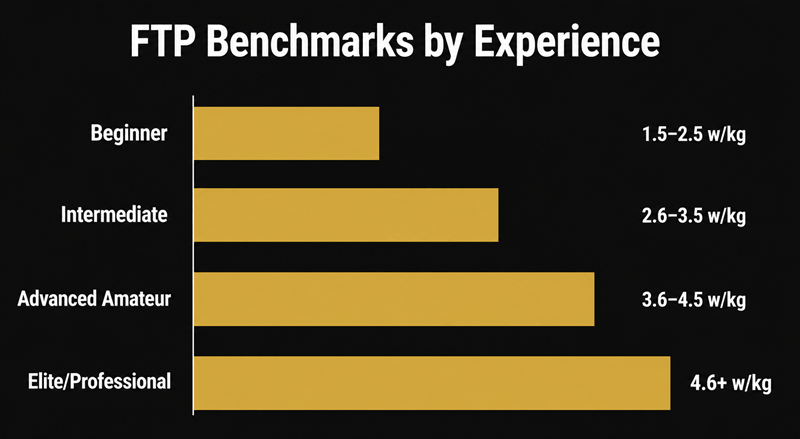
FTP benchmarks by age fall into four broad experience tiers: beginners produce 1.5–2.5 w/kg, intermediate riders 2.6–3.5 w/kg, advanced amateurs 3.6–4.5 w/kg, and elite athletes 4.6+ w/kg. Peak FTP typically occurs between the late 20s and mid-40s, but well-trained masters cyclists can maintain competitive power output well into their 50s and 60s through structured training and disciplined recovery.
If you train with power, you’ve probably asked the question: is my FTP actually any good? Raw wattage without context tells you almost nothing. A 260-watt FTP means something entirely different for a 56-year-old masters rider returning from a multi-year break than it does for a 27-year-old Category 3 racer. Understanding FTP benchmarks by age and experience level gives your numbers real meaning—and helps you set training goals that are challenging without being disconnected from your actual physiology.
Why FTP Isn’t a Universal Standard
Functional Threshold Power is defined as the highest average power you can sustain for approximately 60 minutes. It’s the cornerstone of structured power training because it defines your training zones and predicts aerobic performance more reliably than almost any other single metric. But FTP is shaped by variables that shift across a lifetime—mitochondrial density, slow-twitch muscle fiber development, lactate clearance efficiency, and aerobic enzyme activity. All of these respond to training, and all of them change with age. That’s precisely why a single universal benchmark misses the point.
How Physiology Changes FTP Across Age Groups
Junior and U23 riders often carry high VO2 max potential, but lactate threshold—the physiological engine of FTP—continues developing well into the mid-20s. Coaches who work with developing riders prioritize a broad aerobic base over early threshold specialization. A training history built on long, varied riding creates a higher FTP ceiling at 30 than one built around grinding threshold intervals at 17. The aerobic infrastructure has to come first.
Cyclists in their late 20s through mid-40s occupy the peak FTP window. Years of accumulated endurance work produce deep mitochondrial density and refined fat oxidation. When that aerobic foundation is paired with targeted threshold work—sweet spot blocks, over-under intervals, and block periodization cycles—power-to-weight ratios typically reach their ceiling during this stage. Training quality matters most here, and results respond directly to systematic overload and recovery.
Masters cyclists—those 50 and older—face measurable physiological shifts. VO2 max declines roughly 1% per year after age 40, and peak power follows a similar curve. But FTP is not the same as VO2 max. Sustained threshold power depends more on lactate threshold and neuromuscular efficiency, both of which respond to training longer into life than maximal power does. Well-trained masters riders in their 50s and 60s consistently outperform untrained riders half their age. Resistance training off the bike also measurably slows the age-related loss of type II muscle fiber, which supports sustained wattage at threshold.
FTP Benchmarks by Age and Experience Level
Use these w/kg ranges as reference points rather than rankings. Body weight, testing protocol, altitude, and equipment all influence the number you produce on a given test day.
- Beginner (under 2 years of structured training): 1.5–2.5 w/kg
- Intermediate (2–5 years, consistent structured training): 2.6–3.5 w/kg
- Advanced Amateur (5+ years, competitive club or masters racing): 3.6–4.5 w/kg
- Elite and Professional: 4.6+ w/kg — top World Tour climbers frequently exceed 6.0 w/kg
At the advanced amateur tier, masters riders typically land between 3.6 and 4.0 w/kg, while younger athletes at the same experience level tend to cluster toward the upper half of that range. Gender also plays a role—elite women generally produce numbers around 10–15% lower in absolute watts but compete on identical w/kg benchmarks relative to their category.
Using FTP Benchmarks to Drive Actual Progress
Test on a consistent schedule. FTP testing every four to six weeks gives you a reliable trendline. Flat numbers across multiple test cycles signal that your training stimulus needs to change—not your effort level, but your program structure.
Change the overload variable. If you’ve run the same interval session for months, your body has adapted and stopped responding. Adjusting work-to-rest ratios, shifting to block periodization, or changing interval duration restarts the adaptation signal. Block periodization—concentrating specific stressors into dedicated weeks followed by a structured recovery week—frequently triggers FTP gains that distributed training cannot.
Protect recovery as a training variable. Physiological adaptation occurs between sessions, not during them. Riders who accumulate high training load without adequate recovery regularly show stagnant or declining FTP despite significant perceived effort.
Address nutrition timing. Pre-ride carbohydrate availability and post-session protein intake are both measurable levers on power output and recovery rate. They belong in any serious FTP development plan.
FTP benchmarks by age tell part of your performance story—the part rooted in physiology, training history, and accumulated work on the bike. Your number reflects every interval you’ve completed and every recovery day you didn’t skip. Use the benchmarks as a compass to orient your training, not a ceiling that defines what you’re capable of.
Frequently Asked Questions
What is a good FTP for my age?
A good FTP depends more on your training background than your age alone. Intermediate cyclists across all ages target 2.6–3.5 w/kg, while advanced amateurs aim for 3.6–4.5 w/kg. If you’re new to structured training, 1.5–2.5 w/kg is a reasonable starting range. Focus on your personal trend over time rather than comparing directly to riders with different training histories or body weights.
Does FTP decline with age?
FTP does tend to decline with age, but the rate depends heavily on training consistency. VO2 max drops roughly 1% per year after 40, but lactate threshold—the physiological basis of FTP—responds to training longer into life than peak power does. Masters athletes who train consistently and include off-the-bike strength work often maintain strong FTP numbers well into their 60s, significantly outperforming untrained riders decades younger.
How often should I test my FTP?
Testing FTP every four to six weeks is the standard recommendation for athletes in a structured training block. This frequency captures meaningful adaptations without interrupting training rhythm too frequently. If you’re using a ramp test protocol, the lower physiological cost means you can test closer to the four-week mark. Traditional 20-minute or 60-minute tests are more taxing and are better suited to six-to-eight-week intervals.
Want a Training Plan Built Around Your FTP?
Stop guessing at your zones. Answer 7 quick questions and get a personalized FTP roadmap built around your equipment, schedule, and biggest limiter.
James Hickman is a former USA Cycling Expert-level coach who has worked with cyclists at every level, from beginners to competitive racers. He served as a coach for the Leukemia & Lymphoma Society’s Team In Training program, helping riders prepare for and complete century events. A Masters-category racer himself, he competed and earned podium finishes in Southern California events and holds a Platinum finish at El Tour de Tucson, completing the 100 miles+ in under five hours.
Sponsored · Competitive Cyclist
We are an affiliate for Competitive Cyclist and JensonUSA and earn from qualified purchases with no cost to you. This way we can provide you with competitive pricing and products.