

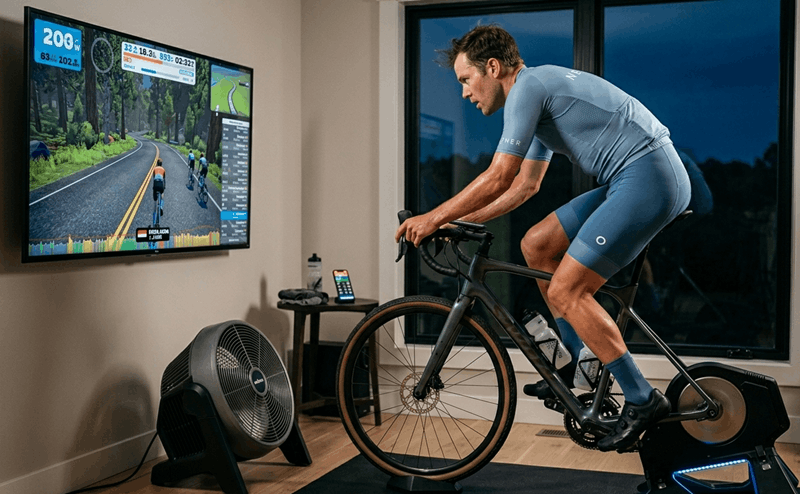
Quick Answer: FTP in cycling is the highest average power you can hold for about 60 minutes, and it’s the number most training plans use to set your zones. Critical Power (CP) is a related but more precise metric, built from several maximal efforts instead of one. For most riders, FTP is the practical day-to-day tool — CP is the deeper layer you reach for once FTP stops telling you enough.
I get asked about this distinction more than almost any other power metric question: what’s the real difference between FTP and Critical Power, and does it actually matter for your training?
Short version — yes, it matters, but maybe not as much as the forum debates suggest.
What FTP in Cycling Actually Means
FTP in cycling stands for Functional Threshold Power. It’s defined as the highest average power you can sustain for roughly one hour without your output collapsing. I’ve used this number to build zones for every athlete I’ve coached, from first-year racers to Platinum-finish century riders, because it’s simple to test and easy to retest.
You don’t need a lab. A 20-minute field test, taken at 95% to account for pacing, gets you close enough to train off of. That accessibility is the entire reason FTP became the industry standard — as TrainingPeaks has noted, coaches needed a field-based metric that was repeatable and practical, not a perfect physiological measurement.
Where Critical Power Fits In
Critical Power is a different animal. Instead of one all-out effort, CP comes from several maximal tests at different durations — typically somewhere in the 2 to 15-minute range — plotted against time to build a power-duration curve. The asymptote of that curve is your CP.
What you get from that extra work is a second number most riders never see: W’ (W-prime), your finite capacity for work above CP. It tells you how much “battery” you have for surges, attacks, or hard efforts above threshold before you blow up. FTP doesn’t give you that. It’s a single ceiling, not a fuel gauge.
FTP vs. CP: The Practical Difference
Here’s how I explain it to athletes I coach: FTP answers “what can I hold for an hour.” CP answers “what can I hold indefinitely, and how much do I have in reserve above it.” They’re usually close — often within a few watts of each other — but they’re not measuring the same thing, and they’re built from different protocols.
| FTP | Critical Power | |
|---|---|---|
| Test type | One maximal effort (~20 min) | Multiple efforts at varying durations |
| Output | Single threshold number | Threshold (CP) + reserve capacity (W’) |
| Best for | Setting zones, everyday training | Interval prescription, race-specific pacing |
| Effort to test | Low | Moderate to high |
If you’re racing crits or anything with repeated surges, CP and W’ will tell you more about your limiters than FTP ever will. If you’re building a base or training for a steady-state event like a century or gran fondo, FTP is the more practical tool — it’s what most structured plans, including the ones in our FTP Training library, are built around.
Picking the Right Tool for Your Training
I don’t tell athletes to pick one and abandon the other. FTP is your everyday number — it’s what you’ll retest every 6 to 8 weeks and what your zones are built on. CP is what you bring in when FTP plateaus and you need a sharper diagnostic.
Not sure if your FTP is actually holding you back?
Take the free 7-question quiz and get a personalized training plan built around your current FTP, schedule, and equipment.
A reliable power meter is the foundation either way — without consistent data, neither number means much. Here’s where I’d start if you need an accurate setup for FTP and CP testing.
For testing CP properly, you’ll want at minimum three maximal efforts at different durations — something like a 3-minute, a 7-minute, and a 12-minute all-out test, each with full recovery between. It’s more demanding than a single 20-minute FTP test, which is exactly why most riders skip it and stick with FTP alone.
Common Mistakes I See
The biggest mistake isn’t picking the wrong metric — it’s inconsistent testing. Riders who retest under different conditions (fatigued, fasted, on a different trainer, different warm-up) end up chasing noise instead of real fitness changes. Whichever metric you use, consistency in your protocol matters more than which one you chose.
The second mistake is treating CP as automatically “more accurate.” It’s more detailed, not necessarily more accurate for your purposes. If all you need is a number to set training zones, the added complexity of CP testing may not be worth the extra fatigue it costs you.
If you’re ready to test properly, having the right setup matters. Here’s the trainer combination I recommend for repeatable threshold testing at home:
Bottom Line
FTP in cycling remains the most practical, accessible threshold metric available, and it’s the right starting point for nearly every rider. Critical Power is the upgrade you reach for once you need more resolution — specifically, once you’re racing or training in a way where knowing your reserve above threshold actually changes your pacing decisions.
Test consistently, retest on a schedule, and don’t let metric debates distract from the basics: structured training, adequate recovery, and an honest read on your numbers will do more for your fitness than choosing between FTP and CP ever will.
Related Reading
 Training |  Training |  Training |
FAQ
Is FTP the same as Critical Power?
No. FTP is a single threshold estimated from one maximal effort, usually a 20-minute test. Critical Power is calculated from multiple efforts at different durations and includes a second metric, W’, that FTP doesn’t provide. They’re often close in value but measure different things.
Do I need to test Critical Power if I already know my FTP?
Not necessarily. If your training is built around steady-state efforts and standard power zones, FTP is sufficient. CP testing adds value mainly for riders who need to understand their reserve capacity above threshold, such as racers dealing with repeated surges.
How often should I retest my FTP in cycling training?
Every 6 to 8 weeks is the standard interval I use with athletes I coach, or sooner if you’ve completed a focused training block and expect a meaningful change. Testing under consistent conditions matters more than the exact frequency.
James Hickman is a former USA Cycling Expert-level coach who has worked with cyclists at every level, from beginners to competitive racers. He served as a coach for the Leukemia & Lymphoma Society’s Team In Training program, helping riders prepare for and complete century events. A Masters-category racer himself, he competed and earned podium finishes in Southern California events and holds a Platinum finish at El Tour de Tucson, completing the 100 miles+ in under five hours.
Sponsored · Competitive Cyclist
We are an Amazon affiliate and earn from qualified Amazon purchases with no cost to you. This is for ANY product that you purchase through our links. We are also an affiliate for Competitive Cyclist and JensonUSA. This way we can provide you with competitive pricing and products.