

Quick Answer: Why Does Your 30s Training Plan Fail After 40?
After 40, your body recovers more slowly, loses VO2max capacity faster, and responds differently to high-intensity work. The training plan that made you faster at 35 now creates fatigue you can’t clear between sessions. The fix isn’t training less — it’s training smarter with proper recovery spacing, more Zone 2, and targeted strength work.
Most cyclists over 40 don’t have a motivation problem. They have a physiology problem they’re solving with the wrong tools. If your numbers are slipping despite consistent training, your plan — not your age — is the issue.
What Actually Changes in Your Body After 40
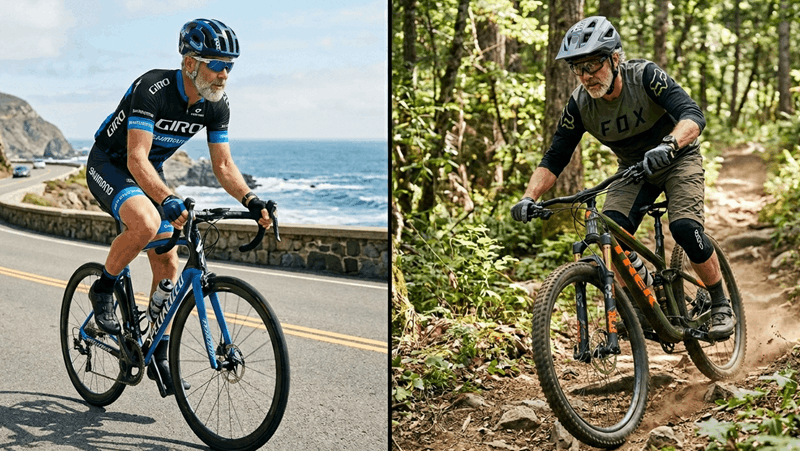
Three physiological shifts happen after 40 that your old training plan wasn’t designed to handle.
VO2max declines at roughly 0.5–1% per year even with consistent training. If you haven’t retested your FTP recently, your training zones are likely calibrated to a number you can no longer sustain — making every interval session either too easy or harder than intended.
Recovery takes significantly longer. The 48-hour turnaround between hard sessions that worked at 35 stretches to 72 hours or more after 40. Stack hard days too close and you accumulate fatigue instead of fitness.
Fast-twitch muscle fibers decline without targeted resistance training. Endurance riding alone won’t preserve the peak power you need to hold wheels, close gaps, or push through threshold efforts.
Why High Volume Plus High Intensity Stops Working
In your 30s, you could absorb a lot — big weeks, back-to-back hard rides, minimal strength work — and recover in time for the next training block. That capacity shrinks after 40.
The problem isn’t that you’re working hard. It’s that your training load is outpacing your recovery capacity. Chronic under-recovery suppresses adaptation. You feel slower because accumulated fatigue is masking whatever fitness gains you’re actually making.
More is not more after 40. Structured is more.
Four Changes That Fix Cycling Training After 40

1. Extend Recovery Between Hard Sessions
Move from 48-hour to 72-hour gaps between threshold or VO2max work. This single adjustment removes most of the chronic fatigue that stalls masters cyclists. It is not optional — it is the most impactful structural change you can make immediately.
2. Shift Your Intensity Distribution Toward Zone 2
Zone 2 becomes your most productive training zone after 40. It builds aerobic base and mitochondrial density without creating the recovery debt that kills adaptation. Target 75–80% of your weekly riding time in Zone 2, with structured intensity twice per week maximum.
If you don’t know your Zone 2 wattage, you need a current FTP test first. An accurate threshold number anchors every zone in your training.
A quality power meter is the most reliable way to train precisely in Zone 2 and confirm your FTP. Browse Shimano Ultegra 8100 PRECISION power meter at Competitive Cyclist — one of the best-stocked retailers for performance training gear.
3. Add Resistance Training Twice Per Week
Loaded resistance training — squats, deadlifts, single-leg press — done twice per week at 6–10 reps with 2–3 reps in reserve preserves fast-twitch muscle fiber and protects peak power output. This is not cross-training. For masters cyclists, strength work is a core component of cycling training after 40, not an optional supplement.
4. Retest and Recalibrate Your FTP
If your FTP number is more than 3 months old, your training zones are wrong. Retest using a 20-minute field test or a structured ramp protocol, recalculate your zones, and build your next training block from accurate numbers. Training to stale zones is one of the most common mistakes masters cyclists make.
A Realistic Weekly Structure for Cyclists Over 40
This framework works for cyclists training 8–10 hours per week with two quality sessions separated by adequate recovery:
- Monday: Rest or mobility work
- Tuesday: Threshold intervals — 60–75 min, 10–15 min warm-up, 2×15 or 3×10 min at FTP, 5–10 min rest between intervals, 10 min cool-down
- Wednesday: Zone 2 — 60–90 min steady
- Thursday: Strength training — 45 min, lower body focus
- Friday: Zone 2 or rest — 60 min easy
- Saturday: Long Zone 2 ride — 2–3 hours
- Sunday: Sweet spot work or full rest depending on accumulated fatigue
Two hard sessions per week (Tuesday, Sunday). Seventy-two hours of separation between them. Adequate Zone 2 volume to drive aerobic adaptation. This is the structural template that works for cycling training after 40.
A smart trainer makes interval execution precise and repeatable — especially for threshold work on recovery-focused training weeks. Browse Wahoo Kickr Core 2 at JensonUSA.
The Bottom Line
Cycling training after 40 is not about doing less. It’s about doing the right things with better spacing and smarter structure.
Your aerobic engine is still trainable. Your FTP can still rise. Your peak power can be maintained. But the plan has to match the physiology you have now — not the physiology you had in your 30s.
Stop repeating a plan that stopped working. Adjust the structure, protect the recovery, and the fitness will follow.
Frequently Asked Questions
Why am I getting slower even though I’m training more after 40?
Training more without adequate recovery creates chronic fatigue that suppresses adaptation. After 40, your recovery capacity decreases — so adding volume without extending rest between hard sessions means your body never fully adapts to the training stress. The result is accumulated fatigue that masks fitness gains and produces slower numbers.
How often should cyclists over 40 do hard interval sessions?
Twice per week is the upper limit for most masters cyclists, with at least 72 hours of separation between hard sessions. Threshold or VO2max intervals done more frequently than this — without adequate recovery — leads to chronic under-recovery rather than fitness improvement.
Does strength training really improve cycling performance after 40?
Yes. Loaded resistance training done twice per week at 6–10 reps preserves fast-twitch muscle fibers that endurance riding alone cannot maintain after 40. This directly protects peak power output and improves durability on longer efforts. For masters cyclists, strength training is a core training component, not optional supplemental work.
Want a Training Plan Built Around Your FTP?
Stop guessing at your zones. Answer 7 quick questions and get a personalized FTP roadmap built around your equipment, schedule, and biggest limiter.
James Hickman is a former USA Cycling Expert-level coach who has worked with cyclists at every level, from beginners to competitive racers. He served as a coach for the Leukemia & Lymphoma Society’s Team In Training program, helping riders prepare for and complete century events. A Masters-category racer himself, he competed and earned podium finishes in Southern California events and holds a Platinum finish at El Tour de Tucson, completing the 100 miles+ in under five hours.
Sponsored · Competitive Cyclist
We are an Amazon affiliate and earn from qualified Amazon purchases with no cost to you. This is for ANY product that you purchase through our links. We are also an affiliate for Competitive Cyclist and JensonUSA. This way we can provide you with competitive pricing and products.