

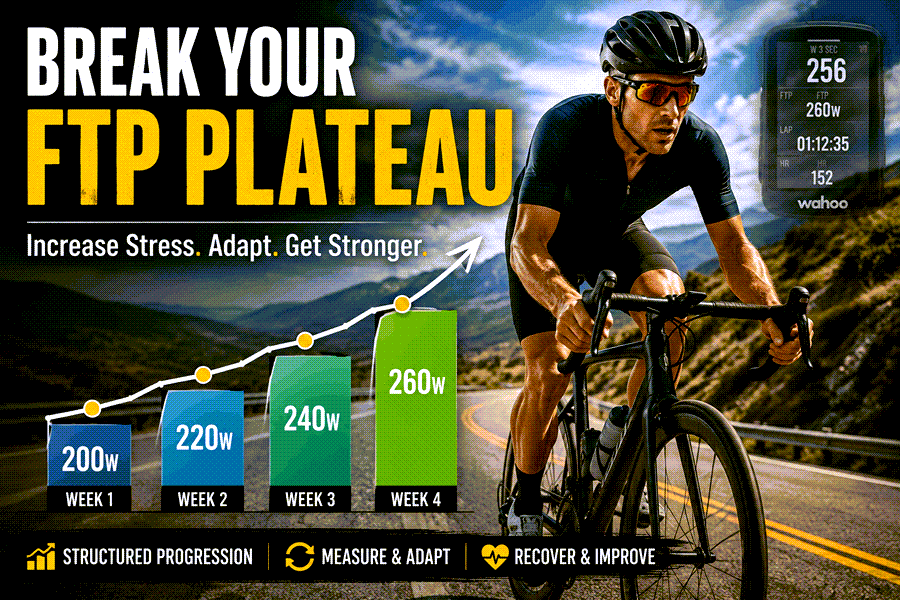
| Quick Answer: Progressive overload is the gradual, structured increase in training stress — intensity, duration, or frequency — that forces your body to adapt and get stronger. For cyclists, the safest approach is raising workload by roughly 5–10% every 1–2 weeks, paired with regular FTP testing to confirm real gains and scheduled recovery weeks to avoid burnout. Skipping either piece is the most common reason cyclists plateau. |
By James Hickman, former USA Cycling Expert-level coach and Masters-category racer
Amazon Affiliate I earn from qualified purchases
What Stalls Cyclists Before They Even Start

Most cyclists don’t plateau because they aren’t working hard enough. They plateau because their training stress isn’t changing. Riding the same intervals at the same power, week after week, gives your body nothing new to adapt to — so it doesn’t. If your FTP hasn’t moved in months despite consistent riding, the problem usually isn’t effort. It’s structure.
The fix is a training principle that underlies every effective plan, whether you’re building toward your first century or chasing a new FTP: progressive overload.
The Mechanism Behind Progressive Overload
Progressive overload works because your body adapts to stress, not to comfort. When you introduce a training load your muscles, cardiovascular system, and energy pathways haven’t handled before, your body responds by building the capacity to handle it next time — more mitochondria, better lactate clearance, stronger muscular endurance. That adaptation only happens if the stress is real but recoverable. Too little stress and nothing changes. Too much, and you’re digging a fatigue hole instead of building fitness.
This is why “just riding more” isn’t the same as progressive overload. The increase has to be deliberate, measured, and followed by enough recovery for your body to actually adapt.
Four Levers You Can Pull
Progressive overload isn’t limited to piling on more watts. There are four main ways to increase training stress, and the best plans rotate between them rather than leaning on just one.
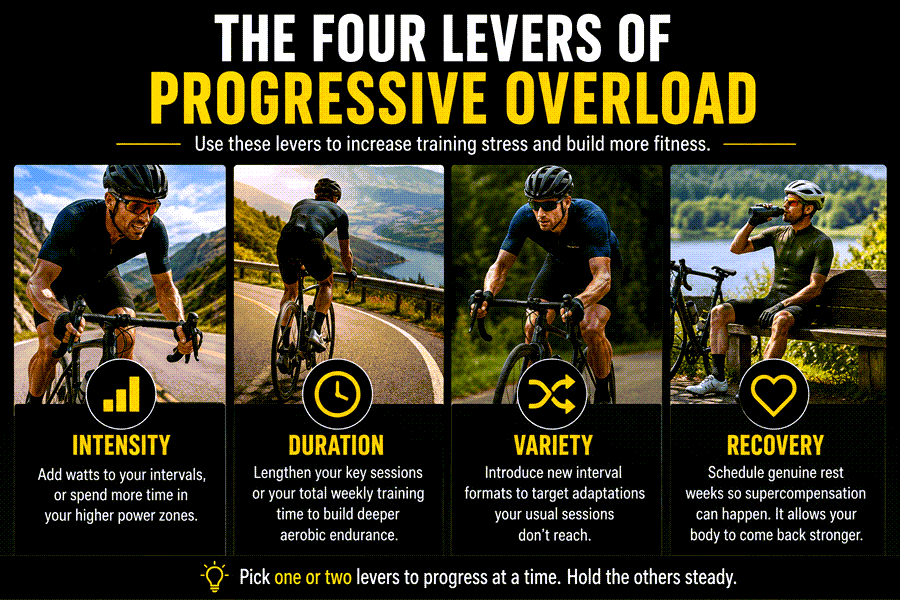
| Intensity | Add watts to your intervals, or extend the time spent in your higher power zones. |
| Duration | Lengthen your key sessions or your total weekly training time to build deeper aerobic endurance. |
| Variety | Introduce new interval formats — over-unders, block training, sweet spot sets — to target adaptations your usual sessions don’t reach. |
| Recovery | Schedule genuine rest weeks so supercompensation can happen. Without this lever, the other three eventually backfire. |
Trying to pull all four levers at once is a common mistake. Pick one or two to progress at a time, and hold the others steady.
Sizing Your Increases — The 5–10% Rule
The safest, most sustainable approach is small and consistent: increase workload by about 5–10% every 1–2 weeks, rather than making large jumps that outpace your body’s ability to recover. A jump from 3 hours to 5 hours of weekly training in a single week isn’t progressive overload — it’s a good way to get injured or overtrained.
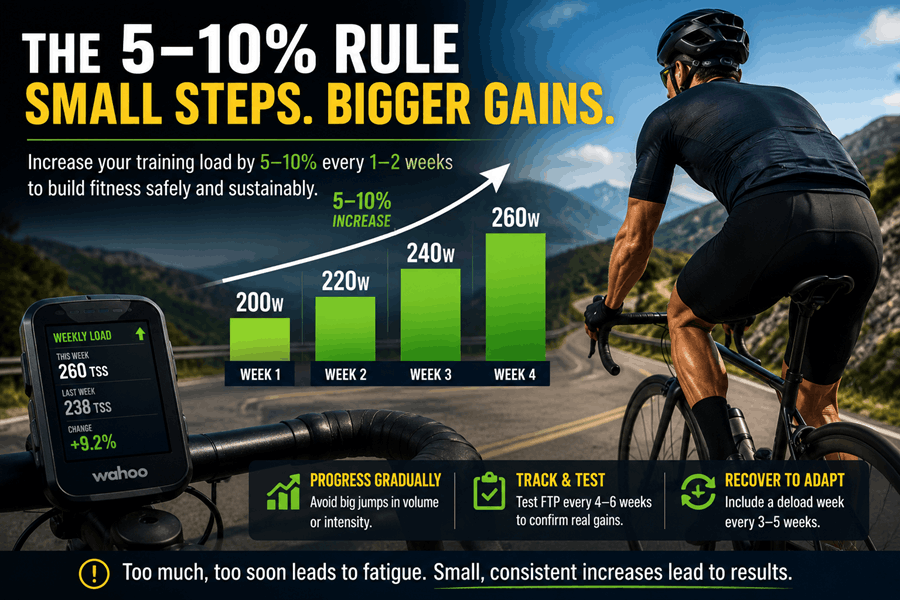
To know whether those increases are translating into real fitness gains — not just more fatigue — you need a reliable check-in. Regular FTP testing keeps your training zones accurate and confirms your power is actually going up, not just your training volume.
Wahoo ELEMNT BOLT GPS bike computer makes tracking these incremental increases straightforward, logging lap power and session data automatically so you can see week-over-week trends without digging through spreadsheets.
Logging your sessions and reviewing trends over time is what catches a plateau early — before weeks of stalled progress turn into months.
Common Mistakes That Undermine Progressive Overload
Even well-intentioned cyclists sabotage their own progress in a few predictable ways:
- Stacking multiple levers at once — increasing intensity and duration in the same week leaves no clear signal for what’s driving fatigue or adaptation.
- Skipping deload weeks — treating recovery as optional rather than part of the plan, which caps how much adaptation can actually occur.
- Training on outdated zones — going months without retesting FTP, so “hard” efforts are either too easy or unknowingly unsustainable.
- Confusing more training with better training — adding volume without a plan for how each week builds on the last.
Putting It Into a Structured Plan
Applying progressive overload on your own takes careful tracking and a willingness to adjust week to week. If you’d rather follow a plan that’s already built around these principles, the FTP Training collection walks you through structured, progressive sessions designed to raise your threshold power without guesswork — useful whether you’re breaking through a long plateau or building your first real base.
Progressive overload isn’t about grinding harder every session. It’s about making each ride purposeful, tracking whether it’s working, and adjusting before fatigue outpaces fitness.
Frequently Asked Questions About Progressive Overload
How much should I increase my training load each week?
A 5–10% increase every 1–2 weeks is a safe, sustainable range for most cyclists. Larger jumps increase injury and overtraining risk without producing faster gains.
How often should I retest my FTP while applying progressive overload?
Every 4–6 weeks is standard. Testing more often can add fatigue without giving your body time to adapt; testing less often means you may be training with outdated, inaccurate zones.
What happens if I increase training load too fast?
Without adequate recovery, rapid increases in training stress typically lead to accumulated fatigue, stalled performance, and higher injury risk — the opposite of the intended adaptation.
Do I need a dedicated rest week, or is one easy day enough?
A single easy day helps with short-term recovery, but supercompensation from several weeks of progressive overload generally requires a full reduced-volume week, typically every 3–5 weeks depending on your training load.
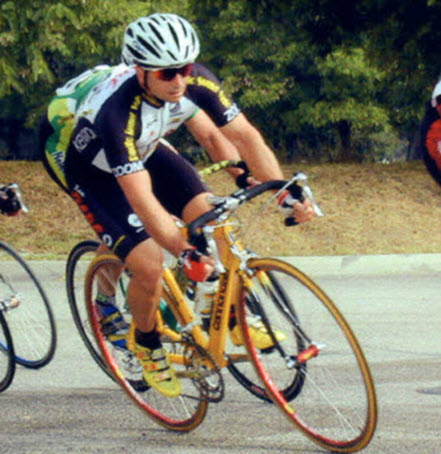
James Hickman is a former USA Cycling Expert-level coach who has worked with cyclists at every level, from beginners to competitive racers. He served as a coach for the Leukemia & Lymphoma Society’s Team In Training program, helping riders prepare for and complete century events. A Masters-category racer himself, he competed and earned podium finishes in Southern California events and holds a Platinum finish at El Tour de Tucson, completing the 100 miles+ in under five hours.
Related Reading
Not sure where to focus your training?
Answer 7 quick questions and get a personalized FTP roadmap built around your fitness level, available training time, and biggest limiter — in about two minutes.
Sponsored · Competitive Cyclist
We are an Amazon affiliate and earn from qualified Amazon purchases with no cost to you. This is for ANY product that you purchase through our links. We are also an affiliate for Competitive Cyclist and JensonUSA. This way we can provide you with competitive pricing and products.